Science Fiction Interactive Fiction Reads Better
Science fiction interactive fiction runs on restricted perception, which is why an empty station reads better in text than it renders on a screen.
Science fiction interactive fiction works because the genre’s best premises are about limited information, and prose is the only medium where limited information is free. A dark corridor costs a film crew a lighting rig and costs a sentence nothing. When you wake alone on a station with most of the lights out, the story and the medium want exactly the same thing.
- Science fiction interactive fiction runs on restricted perception, which text supplies at no cost.
- The empty-station premise deletes every character who could explain the situation, so the world has to be read from objects.
- Suspended, a 1983 Infocom game written by Mike Berlyn, gives you six robots instead of a body, each with one channel to the world.
- Infocom’s original ZIL source for its science fiction games is public on GitHub, released for education, discussion and historical work.
- A live narrator answers a move no author anticipated, and gives up the guarantee that a person wrote the reply well.
Why science fiction interactive fiction suits prose
Two costs decide where a genre settles. Scale is the obvious one: a ringworld, a derelict fleet, a city under ice each cost a studio a year of art direction and cost a writer about a line. The subtler cost is ignorance. Film has to show you the room before your character has looked at it, and every frame leaks information the story would rather withhold.
Text has no such leak. You know what has been said, in the order it was said, which is the exact condition most science fiction plots depend on. The genre is full of people reconstructing what happened here from evidence. Prose lets you reconstruct it at the same rate they do.
There is a third fit, less often mentioned. Science fiction asks you to hold an unfamiliar system in your head — a protocol, a chain of command, a machine with rules about who may open which door. Sentences are how systems get explained everywhere else in life, from manuals to law. A genre made of rules ends up in the medium made of rules.
What does the empty station premise actually do?
It removes the exposition-giver. In most stories somebody tells the protagonist what is going on: a captain, a briefing, a voice on the radio. Empty the station and nobody is left to say it, so every fact has to arrive as an object — a duty roster, a door welded from the wrong side, a meal that stopped halfway.
That does two things at once. Your ignorance and the character’s ignorance line up exactly, which is rare and hard to arrange otherwise. And it makes reading the activity of the story rather than a pause before it: looking closely at a thing is not preparation for the plot, it is the plot.
It also solves a problem specific to stories you steer. A populated world has to answer any question you put to anyone, which is where both hand-written and generated fiction go thin. A crewless corridor owes you nothing beyond what is physically in it. The premise pays three debts of its own, though:
- Something has to have happened. An empty station is a question, and a question with no answer behind it reads as an empty exercise within an hour.
- The absence has to have a shape. Four hundred people do not vanish tidily. What they left mid-gesture is the whole vocabulary the story has left to speak with.
- The silence has to break eventually. Isolation is a pressure, and pressure that never releases stops being felt. Holding it for as long as possible is the same discipline that horror interactive fiction uses when it withholds.
How Suspended turned the reader into an instrument
The sharpest use of restricted perception in the form is more than forty years old. The archived source repository for Suspended describes it as “a 1983 interactive fiction game written by Mike Berlyn and published by Infocom”, and the idea lives in a file in that tree called robots.zil. You are not walking the facility. You are underground and asleep, issuing orders to six robots, and each one has a single channel to the world.
| Robot | What the game’s own source says about it | The channel it gives you |
|---|---|---|
| Iris | “transmits high-resolution pictures of her surroundings” | Sight |
| Auda | “a listening robot” with “large dish receptors” | Hearing |
| Sensa | “sensory pads and mechanisms for detecting abnormal activity” | Disturbance |
| Poet | “For diagnostic information on pattern and flow, have Poet touch objects” | Diagnosis by touch |
| Waldo | “primarily a building and repair robot” with “extensions for manipulating objects” | Hands |
| Whiz | “our interface to the CLC”, by way of “a small connecting cable” | Records |
No single robot perceives enough to act on. Iris in an unlit room reports nothing; Auda hears what Iris cannot see; Poet has to touch a thing before it means anything. You assemble one world out of six partial reports, and the assembling is the game. A novel can describe that condition. An interactive story can make you perform it.
Reading the source of the games themselves
The Infocom archives are worth knowing about for their own sake. Alongside Suspended sit Planetfall, “a 1983 interactive fiction game written by Steve Meretzky”, and The Hitchhiker’s Guide to the Galaxy, “a 1984 interactive fiction game written by Douglas Adams and Steve Meretzky”.
Each repository holds the ZIL source, including files used and discarded in production. The README files are careful about what this is: a snapshot of the Infocom development system at the time of shutdown, published “for education, discussion, and historical work”, with no open license and no known way to compile the code into a playable file. It is a reading archive, not a distribution.
Where to read science fiction interactive fiction now
The genre arrives through the same doors as any other, and the choice is practical rather than literary. Our guide to fantasy interactive fiction and where to start breaks the four formats down in full; what follows is what each one does specifically for science fiction.
- Parser games. You type, the world answers. The deepest simulated machinery in the form lives here, which suits a genre about machinery, and so does the cost: verb vocabulary, mapping, the occasional stalled hour.
- Choice-based novels. You tap a listed option. Strong on political and first-contact plots where the interesting question is which of four bad decisions you sign your name to.
- Printed gamebooks. Numbered sections, sometimes dice. The oldest route, and the only one that survives a dead battery.
- Live narration. You write your move in your own words and a narrator answers in prose. No route off the marked path, because no path was marked.
What changes when the station is written live
Fabledrift, an interactive fiction app for Android, keeps a science fiction world called Ironreach Station, rated 16+, whose premise is a single line: you woke up alone on a station that should have a crew of four hundred. Nothing in it is pre-written. Each scene is generated as you reach it by a narrator handed the story’s structured memory — facts, characters, places, promises — on every turn.
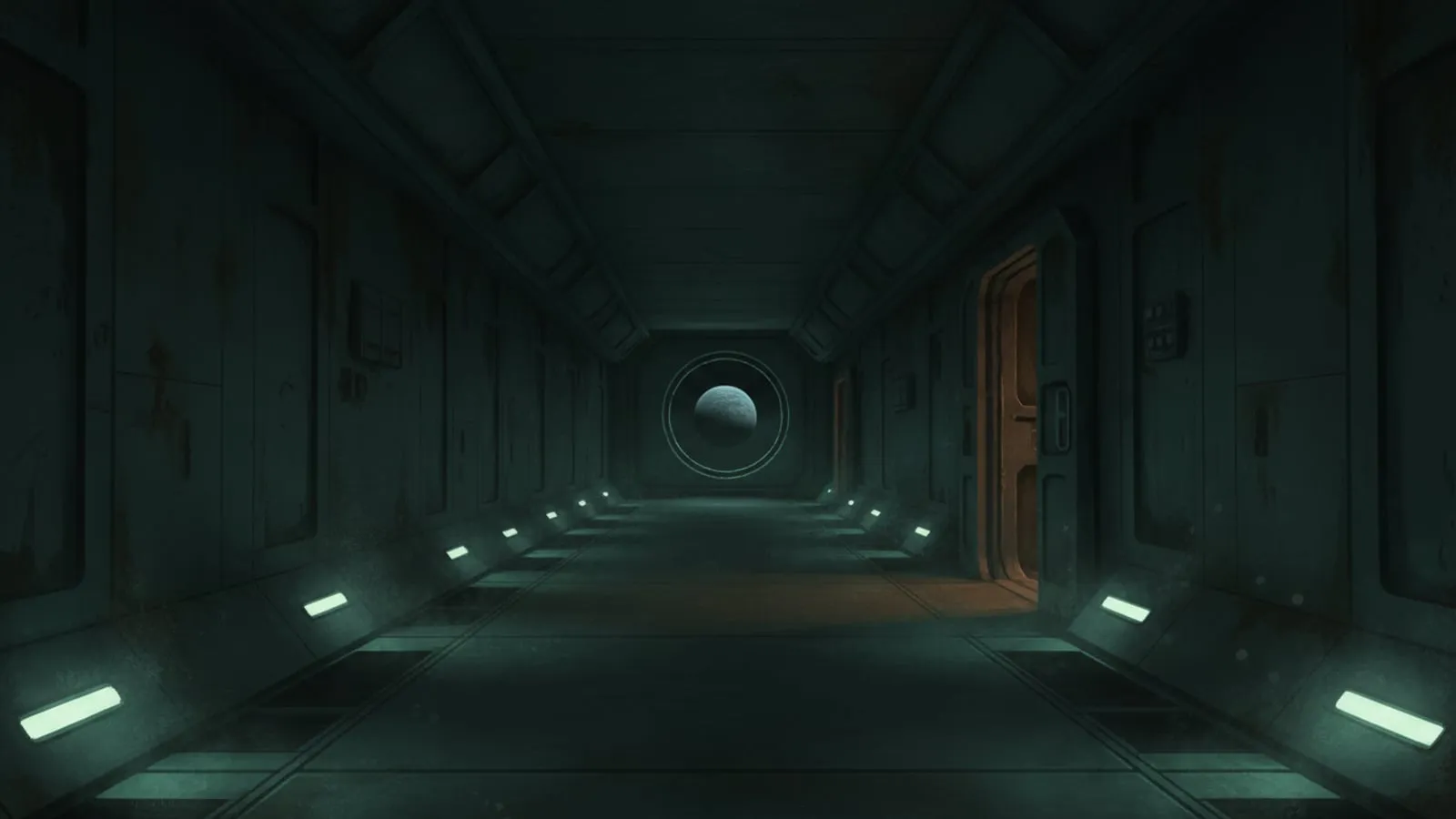
The trade is real in both directions. A pre-written station is finite and exact: every locked door was locked on purpose by somebody, and the puzzle behind it was tested. A live one will answer the question you actually asked at 1 a.m., including the one about the handwriting on the manifest, and cannot promise that the answer was worth asking for.
What it does keep is the page. There are no stats, dice or quest logs in the way, for reasons worth separating from nostalgia, and memory is never a paid feature — every reader gets the full record of what the narrator remembers. If you are weighing the wider field first, our comparison of AI Dungeon alternatives sorts it by what each product optimizes for.
What to do in your first hour aboard
Restricted perception is a reading skill as much as a design one, and it takes about ten minutes to pick up. Read the room before you move through it. Treat every absence as a sentence: not that the crew is gone, but that this particular person left this particular thing open.
Ask one question at a time, of one object, and let the answer change the next question rather than working through a checklist. Suspended is the argument in its purest form — six senses, none of them sufficient, all of them yours. Whether the corridor was written in 1983 or thirty seconds ago, the station only ever tells you what you thought to look at.
Frequently asked questions
What is science fiction interactive fiction?
A science fiction story told in prose that you steer as you read, by typing commands, choosing listed options, or writing your own move for a narrator to answer. The genre and the medium fit because both are built on partial information.
Why do so many sci-fi text adventures start with an empty ship or station?
Because emptying the setting removes every character who could explain the situation, so each fact has to arrive as a physical object you find and read. It also aligns your ignorance with the character's, which is difficult to arrange any other way.
What is Suspended and why is it unusual?
Suspended is a 1983 Infocom game written by Mike Berlyn in which you never move through the facility yourself. You issue orders to six robots, each with a single channel to the world, and assemble one picture of events from six partial reports.
Can I read Infocom's original science fiction source code?
Yes. Infocom's ZIL source for games including Planetfall, Suspended and The Hitchhiker's Guide to the Galaxy is published on GitHub for education, discussion and historical work. The repositories note that there is no known way to compile them into a playable file and no open license applies.
How is an AI narrator different from a classic sci-fi text adventure?
A classic game answers only what its author anticipated, precisely and consistently. An AI narrator composes each scene live, so it can answer a sentence nobody planned for, at the cost of the guarantee that a person wrote the reply well.