Why a Text Adventure Without Stats Reads Better
A text adventure without stats drops the dice, the XP bar and the inventory grid, so nothing on the page competes with the prose. Here is what replaces them.
A text adventure without stats removes the numbers — no skill scores, no hit points, no dice, no experience bar — and settles every outcome inside the prose instead. Difficulty does not vanish with them; it moves into the writing, where a failure has to be described rather than subtracted. What you get back is the whole screen, and a kind of attention that only shows up when there is nothing on the page to manage.
- Stats entered the tradition as a resolution system, because a printed gamebook had no way to settle a contested outcome on its own.
- Removing stats does not remove consequence; it moves consequence into the text, where it has to be written out.
- The three languages most interactive fiction is authored in — Inform, Twine and ink — describe themselves as tools for narrative rather than for systems.
- A stat sheet asks you to optimize and a page asks you to read, and the two habits compete for the same attention.
- A character-creation screen shown before the first sentence tells you which of the two an app was built for.
What a text adventure without stats actually removes
Less than the name suggests. Out go the character sheet, the dice, the experience bar, the level-up, the inventory grid, the quest log and the counters parked in the corners of the screen. What stays is everything that made you open the story in the first place: a situation, a voice, a decision that costs something, and a paragraph you have not read yet. Objects do not leave with the grid that listed them, and how inventory in AI stories is kept as a record instead is worth a look on its own.
What it does not remove
Failure stays. So does scarcity, and the feeling that you can lose something you wanted. A door you could not open is still shut two scenes later. A person you insulted early still declines to help you when it matters. Consequence was never really the number; it was the fact that persisted and got mentioned again, and text holds facts perfectly well.
The difference is where you look to find out how you are doing. With stats, you check a panel. Without them, you reread the last paragraph, because that is the only place the answer exists. Some readers find this unnerving for an evening and then find it hard to go back.
Why the numbers were there in the first place
Because paper cannot adjudicate. A printed gamebook has no way to decide whether your swing lands or your lie holds, so it borrowed the tabletop’s answer: give the reader two or three scores, hand them dice, let arithmetic stand in for a game master. That was an achievement rather than a mistake. It let a book contain genuine uncertainty, which no amount of branching alone can produce. Solo tabletop players still use that answer deliberately, which is its own comparison — see solo RPG journaling against an AI story app for who ends up writing the prose in each.
Early computer adventures kept the machinery for a different reason. A program needs state it can test — a flag for the unlocked door, a counter for the lamp — and once you are already tracking state, exposing some of it to the player costs nothing. Numbers on the screen were, at first, a side effect of how the thing was built.
The authoring tools never claimed to be about systems
The languages the tradition actually runs on say what they think they are for. Inform 7 calls itself “a programming language for creating interactive fiction, using natural language syntax,” and describes itself as “widely used as a medium for literary writing.” Twine is “a tool for telling interactive, nonlinear stories.” ink is “inkle’s scripting language for writing interactive narrative.”
Not one of them names a mechanic. Stats are something an author adds when a particular story wants them, in the same way a novelist might add a map. The default, in every one of these tools, is prose and structure. Combat sits in the same optional category, which is its own argument: interactive fiction without combat shows what supplies the pressure once the fight is gone.
What replaces the stat sheet
Each job a number was doing has a textual equivalent, and in most cases the textual version carries more information. The table below pairs them.
| What the stat did | How it worked | What does the job without it |
|---|---|---|
| Settle an attempt | Roll against a score | The scene describes the attempt and how it went |
| Track damage | Subtract from a stamina total | The body is described: a limp, a shaking hand, a wound you have to explain to someone |
| Record what you carry | Inventory grid | The object is mentioned when it becomes relevant |
| Mark progress | Experience points and levels | You are further in, and people treat you differently |
| Remember what happened | Flags and counters | A record of facts, characters, places and promises, kept and consulted |
The last row is the one that decides whether a stats-free story holds together. A flag is cheap and reliable; prose is neither, unless something is deliberately keeping track behind the page. This is the whole engineering problem of live-narrated fiction, and we wrote it up separately in why AI story games forget.
Why readers leave gamified story apps
Usually not because they stopped liking the genre. Two things wear them down. The first is that a visible number quietly becomes the goal: a bar that can be filled will be filled, and within an hour you are choosing the line that raises Persuasion rather than the line your character would say. The mechanic did not ask for that. It just made one option measurable and left the other one merely true.
The second is interruption. Reading works by absorption — you stop noticing the device — and a HUD is designed to be noticed. Every counter, timer and toast is a small pull back to the surface. Individually trivial, they add up to an evening where you never quite sank in, and readers describe that as the app being tiring rather than as the app being wrong.
Neither complaint is an argument against games. It is an argument about which thing you thought you were doing when you opened it. Our guide to interactive fiction apps for adults sorts the store category along exactly that line.
How to spot a reading-first text adventure before you install it
Three checks, none of which requires downloading anything.
- Look at the first screen the app shows. A story you have to build a character for has already told you what it is. If the sentence comes before the setup, reading is the point.
- Read the verbs in the store description. “Build,” “level,” “collect” and “compete” describe a system. “Read,” “story,” “chapter” and “ending” describe a book. Products are honest about this, because they are selling to the audience they want.
- Look at one screenshot with the text blurred. If numbers, bars, portraits or currency ring the paragraph, you will be managing them. If the screen is a block of prose with a few quiet lines underneath, you will be reading. For the rest of the field, our comparison of AI Dungeon alternatives covers what each product optimizes for.
There is a fourth check, harder to run from a listing: find out what happens when you try something the design did not anticipate. A system says no. A story says what happened next.
The page with the numbers gone
Fabledrift, an interactive fiction app for Android, is built on this premise: no stats, no dice, no XP, no inventory grid, no quest log. Every scene is written live by a narrator that is handed the story’s memory — facts, characters, places, promises — on every turn, so the persistence a flag used to provide comes from a record rather than from a panel on screen.
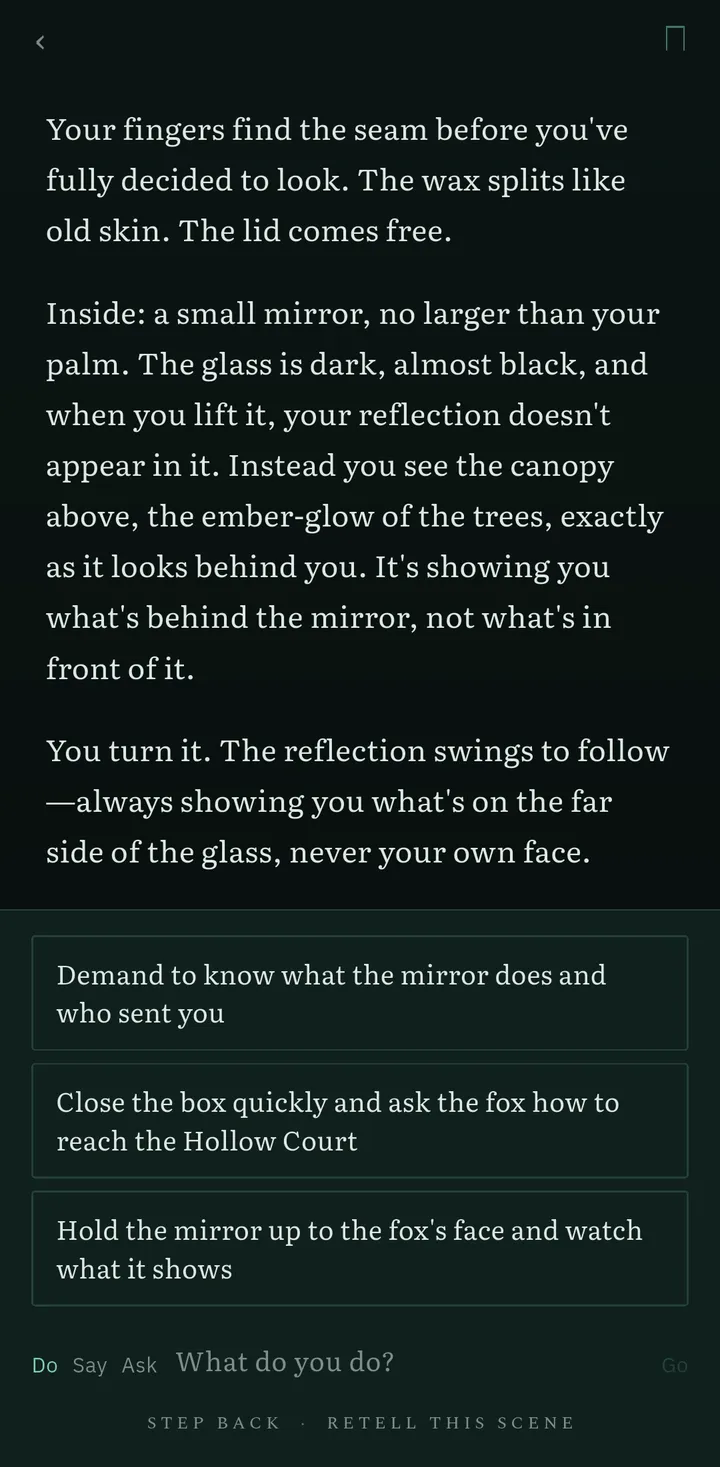
You write your own move in your own words, and the narrator leaves two to four openings on the page if you would rather take one. An attempt happens even when it fails. An impossible move becomes a scene instead of an error message. If a scene lands badly you can retell it, or step back to an earlier one, and both are free — which is the stats-free equivalent of a saved game, minus the bookkeeping.
What that leaves on the screen is a paragraph and a question. It is a narrow design, and it is not for everyone; a reader who wants to optimize a build will find nothing to hold on to. But if you have ever closed a story app because you were tired of playing two things at once, the version with the numbers taken out is worth an evening. If you want to get more out of that evening, how to write a good move is the practical half of this argument.
Frequently asked questions
What is a text adventure without stats?
An interactive story that settles outcomes in prose rather than in numbers: no skill scores, no hit points, no dice, no experience bar. Your attempts still fail and still cost something, but the cost is described in the next scene instead of subtracted from a sheet.
Is a text adventure without stats too easy?
Difficulty moves rather than disappears. It becomes whether you noticed the detail, asked the right question, or made a promise you cannot keep, and the story answers in the same register it was written in.
Are stats bad in interactive fiction?
No. They are a resolution system that does one job well, especially in printed gamebooks and choice-based novels where an author needs a fair, repeatable way to settle a contested outcome. The objection is to carrying that machinery into something you sat down to read.
How can I tell whether a story app has stats before installing it?
Look at one screenshot and at the first screen the app shows you. Numbers, bars and portraits around the text mean you will be managing them, and a character-creation step before the first sentence tells you which of the two things the app is.
What is the difference between a text adventure without stats and a Choose Your Own Adventure book?
A gamebook without stats is still fully pre-written, so every path you take is one an author anticipated. A live-narrated text adventure composes the next scene in response to what you wrote, trading guaranteed craft for the freedom to try something nobody planned for.