Reading Interactive Fiction Slowly, One Scene a Day
Reading interactive fiction slowly, a scene a day, is a practice rather than a limit. The gap between sittings is where the story sets.
Reading interactive fiction slowly — one scene in the evening, then the app closed — works because of the gap, not in spite of it. A story you put down for a day stops being text on a screen and becomes something you carry around slightly wrong: a name you half remember, a promise you are not certain you made. The next scene lands against that, and it lands harder than a scene that only has to follow the paragraph above it.
A scene is a complete unit of interactive fiction, and choice-based engines have divided stories into scene files for years. Memory of a story fades with time between sittings, and the effort of recalling it is part of what fixes it. Novels were once issued in parts, and the readers who waited between them were not reading a worse book. One scene a day means tomorrow’s move is chosen by someone who has had a day to think, not by momentum. A slow pace is the simplest defense against reading an endless story until it stops meaning anything.
Why reading interactive fiction slowly beats a long sitting
Long sittings flatten this form in a specific way. Somewhere around the fourth or fifth consecutive scene you stop deciding and start continuing: you take the opening the narrator left on the page because it is there, and the story becomes a corridor you walk down. Speed is not the fault. The fault is that nothing intervenes between one decision and the next.
A day is enough to intervene. The move you make tomorrow is made by someone who has been carrying the situation around at odd hours — in a queue, half asleep, while doing something unrelated — and who has probably thought of a better idea than the one that was obvious last night. That thinking is free, it happens without effort, and it is the whole difference between playing a story and reading one.
There is a second effect, less obvious. When a story arrives one scene at a time, each scene has to survive on its own. You notice the prose. You notice when a character says something out of key, when a place is described twice in different words, when the narrator has quietly lost track of who is holding the lantern. Readers who move quickly forgive all of that, because momentum covers it.
What happens to a story between sittings
Something is lost, and something is gained, and the second is larger. The clearest model of the first comes from spaced repetition software, where memory is treated as a quantity that decays. The public documentation for the Free Spaced Repetition Scheduler defines retrievability as the “probability of recall” and stability as the “interval when R=90%” — the span after which a memory still has roughly a nine-in-ten chance of returning.
Fiction is not a deck of flashcards, and the analogy should not be pushed far. But the shape is right. What you can retrieve about a story is not a fixed set of facts; it is a set of probabilities that fall as the days pass, and the act of pulling something back is itself work that makes the thing more durable next time.
That is why the fourth day of a story feels different from the fourth scene of an evening. On the fourth day you have to reach for the name of the woman at the gate. Reaching for it is what turns her from a detail into a person you know. A binge never asks you to reach, so nothing consolidates and the cast stays flat.
The version of this the serial novel already knew
Novels were once issued in parts, weeks apart, and the form adapted to the interval rather than around it. Chapters ended on something unresolved, because the reader had to hold it. Characters were reintroduced with a gesture rather than a name. None of that was a limitation of printing; it was a craft built for a reader who would be away for a while and would come back carrying an imperfect copy of the book.
Is one scene a day enough to hold a story together?
Yes, provided two things are true: the scene is a real unit, and the story keeps a record you can consult. The first has been settled for a long time in interactive fiction. ChoiceScript, one of the older choice-based engines still in daily use, builds a game out of scene files and moves between them explicitly — its documentation describes *finish as the command that ends the current scene and moves on to the next one in the game. The scene is where the form has always been willing to stop.
The second condition is where live-written stories differ from static ones. A branching book has one text; you can always page back. A story generated as you read it has only whatever record the app keeps, which is why the record has to be visible.
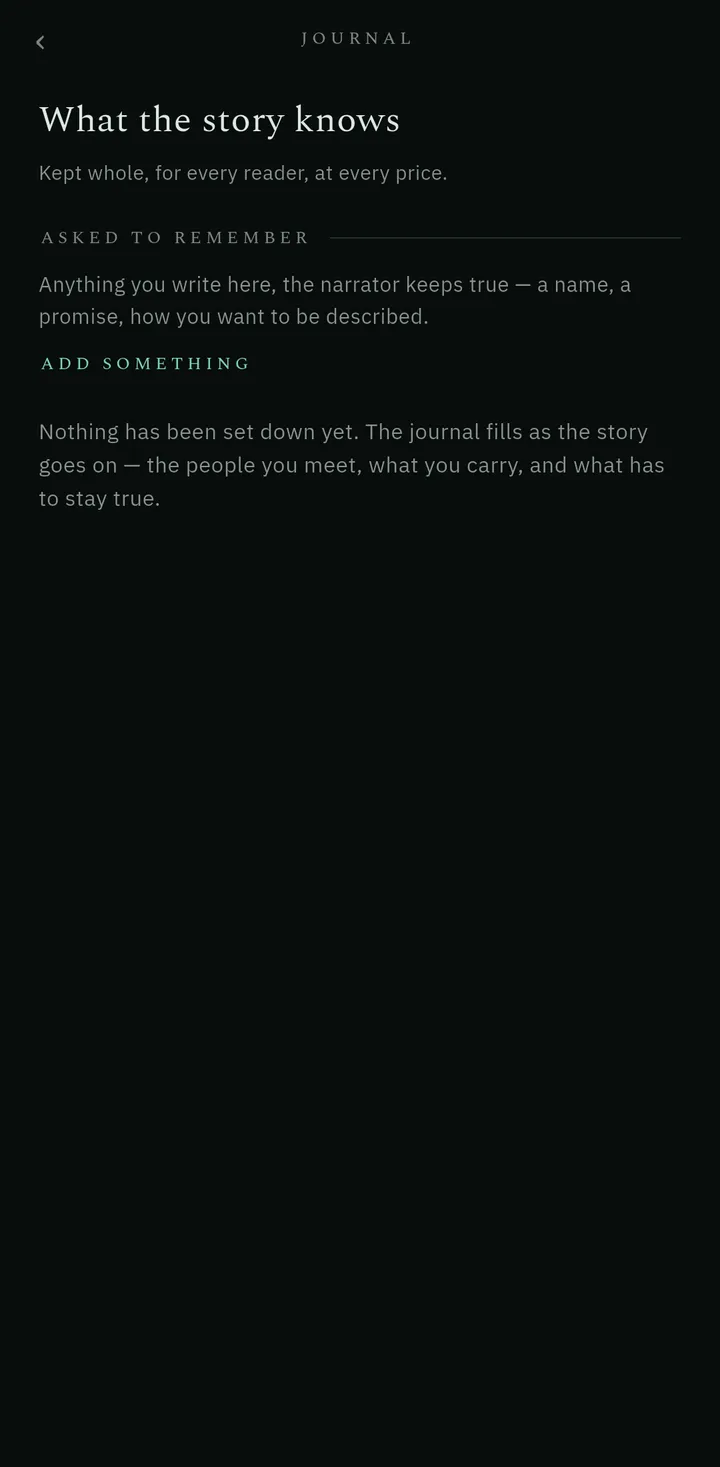
In Fabledrift, an interactive fiction app for Android, every scene is written live by a narrator that is handed the story’s structured memory — facts, characters, places, promises — on every turn, and a journal shows you what that record currently holds. A reader coming back after two days opens the journal, reads six lines, and is oriented. Memory is never a paid feature here, which matters more for slow readers than for fast ones: the gap is exactly when you need the record most.
How to hold a one-scene-a-day habit
Attach it to something already fixed. The readers who keep this pace do not schedule it; they put it where a habit already exists — the twenty minutes before sleep, the first coffee, the middle of a commute — because a practice tied to an existing routine survives a bad week. A pace that depends on remembering will not.
Three patterns, and what each one actually costs:
| Reading pattern | What it costs you | What it gives you |
|---|---|---|
| Several scenes in one sitting | Decisions made on momentum; prose you stop noticing | A lot of story in one evening, and a vaguer memory of it |
| One scene a day | Patience, and the ability to stop mid-story | A day of thinking behind every move; sharper returns |
| One scene a week | Real forgetting; a recap needed each time | A story that feels like a serial, and almost no daily claim on you |
A few smaller rules help.
- Read the scene twice before answering. The second pass is where the detail you would have missed usually is.
- Write your move, then leave it a minute. The first idea is generally the one the narrator already offered you.
- Note one line for tomorrow. Not a summary — the single thing you want to be true when you come back.
- Stop at the scene, not at the resolution. Ending on an open question is what makes the next day’s reading pull.
The economics tend to agree with the pace. Where an app meters scenes rather than time, a daily habit usually fits inside the free allowance: reading with the Apprentice in Fabledrift is free every day — five scenes a day in the first week, then one a day, for good — so the slow reader stays inside it while a long sitting draws on credits. The pricing page sets out the plans and the daily allowances, and we have taken apart what a credit actually buys in AI story credits explained.
When the pace is wrong for the story
Not every stretch of a story wants a day between scenes. A chase, an argument, an interrogation — anything where the tension is measured in minutes of story time — reads badly in daily installments, because the interval you are adding contradicts the interval the scene is describing. Read those in one go. Reading interactive fiction slowly is a default, not a rule, and the story usually tells you when to break it.
Endings are the other exception. A story approaching its close has a shape that wants to be held whole, and stretching the last three scenes over three days is the surest way to arrive at the end having forgotten why it mattered. When you can feel the ending coming, close the distance: read the last movement in one sitting, the way you would finish a novel at two in the morning. What makes an ending land at all is a separate craft, which we set out in how AI stories end.
Seven scenes, one week, one story
Try it for a week before deciding. One scene a night, at the same hour, with the app closed afterward even when the scene ends somewhere you want to follow. Notice what you are carrying by Thursday: not the plot, which any recap can restore, but the texture — a voice, a room, an obligation you would rather not keep. That residue is what slow reading produces and fast reading does not.
It is also the only real argument for the practice. If after seven days you find you have been thinking about the story during the day rather than only while reading it, then reading interactive fiction slowly has already done the thing it is for, and no further case needs making.
Frequently asked questions
How many scenes a day should I read in an interactive fiction app?
One is enough to keep a story alive, and for most readers it is better than five. A single scene gives you something to think about for a day; five in a row tend to blur into one long corridor you walked down without deciding much.
Will I forget the story if I only read one scene a day?
You will forget some of it, and that is the useful part. What comes back after a day away is what mattered to you, and a story built on a written record can remind you of the rest through a journal or a recap when you open it again.
Is slow reading worse for an AI story that generates scenes live?
No, provided the app keeps a durable record rather than relying on recent text alone. A narrator handed the story's structured memory on every turn answers a scene written a week later the same way it answers one written a minute later.
What is the best time to read one scene a day?
Whatever time you can repeat. Readers who hold the habit usually attach it to something already fixed — the last twenty minutes before sleep, a commute, the coffee before work — because a pace tied to an existing routine survives a bad week.
Does reading slowly cost less in an AI story app?
It can. Apps that meter scenes rather than time usually have a free daily allowance, and a one-scene-a-day habit fits inside it, so a slow reader often pays nothing where a binge reader pays for the sixth scene onward.