AI Story Credits Explained, From Token to Scene
AI story credits explained: what one credit really buys, why a scene costs more later in a story, and how to read without watching a counter.
AI story credits explained in one sentence: a credit is a fixed price you pay for a cost that is not fixed. Underneath sits a bill measured in tokens — the units a language model reads and writes — and one scene costs more of them than the last, because the whole story so far travels with your move. The credit is that curve, rounded into a number you can count.
- A token is not a word: models read text as a sequence of tokens, roughly four characters of English each.
- Model providers price input tokens and output tokens separately, and output always costs more.
- The cost of a scene rises as the story lengthens, because earlier scenes are sent again with every move.
- Caching drops the price of text the model has already been shown to a tenth of the standard input rate.
- A credit hides that variability from you, which is useful when the exchange rate is published and misleading when it is not.
What is a token, and why is it not a word?
A token is a fragment of text, not a word. The tokenizer library tiktoken states it plainly: “Language models don’t see text like you and I, instead they see a sequence of numbers (known as tokens).” Byte pair encoding splits writing into common fragments, which is why a model recognizes the ing in encoding as a piece it has seen a million times before.
The rule of thumb published in Anthropic’s pricing documentation is that one token runs about four characters, or three quarters of an English word. A 400-word scene is therefore something like 530 tokens of new prose. That number is small. What sits in front of it is not.
AI story credits explained: what one credit actually buys
A credit buys one app-defined action, and the app decides what that action is worth. Behind it, the provider bills two separate quantities at two different rates. Anthropic’s published table lists Claude Sonnet 5 at $2 per million input tokens and $10 per million output tokens; every row on that table prices output above input. Reading your story back to the model is cheap. Writing the next page of it is not.
Help pages that promise AI story credits explained tend to stop at “credits let you generate content,” which explains nothing. The chain is short enough to follow all the way down, and it has exactly four links in it.
| Unit | What it measures | Who sees it |
|---|---|---|
| Token | About four characters of text | The model and the invoice |
| Input token | The story so far, plus your move | Priced lower, but there is far more of it |
| Output token | The new scene the narrator writes | Priced higher, and roughly constant per scene |
| Credit | One action, as defined by the app | You |
The fourth row is the one worth staring at. Everything above it is measured; the credit is chosen. That is not automatically dishonest — a fixed price is easier to reason about than a fluctuating one — but it means the exchange rate is a decision the app made about you, and you are entitled to see it.
Why does the same scene cost more later in the story?
Because a story is cumulative and a request is not. Anthropic’s documentation on context windows describes the pattern as progressive token accumulation: each turn’s input contains all previous conversation history plus the current message, and previous turns are preserved completely. Scene forty therefore arrives at the model carrying thirty-nine scenes on its back.
Two things keep that curve from becoming a cliff. The first is caching: a cache hit is billed at a tenth of the standard input price, so the unchanged opening of a long story stops costing full rate on every turn. The second is structural. An app that sends a compact record of facts, characters and promises instead of the raw transcript is sending a few thousand tokens where the transcript would send fifty thousand.
What this means for a flat per-scene price
An app charging you the same credits for scene two and scene two hundred is absorbing that difference. It can afford to because most stories end long before the curve gets steep, and because the average across all readers is what it actually pays. Flat pricing is a promise about your experience, not a description of the underlying bill.
Why do credit systems feel like a shell game?
Because three separate things get blurred together, usually on purpose. The exchange rate goes unpublished, so you cannot tell whether a credit is worth a paragraph or a chapter. Balances expire, so unused value quietly returns to the seller. And the feature that decides whether the story is any good — memory — gets sold as a tier rather than included.
The third is the one that changes what you read rather than what you pay. We have written before about why story memory should never be a paid feature: a narrator that forgets your name on the free plan is not a cheaper product, it is a broken one. Pricing the model is fair. Pricing the continuity is a way of charging you for a defect.
How do you read without watching a counter?
By being told the cost once, before the story starts, and then never again. A number that updates on the page while you read turns a scene into a transaction. You start weighing whether a line of dialogue is worth the tick, which is exactly the kind of arithmetic a good book keeps you away from.
Fabledrift, an interactive fiction app for Android, puts the estimate on the world’s cover and the balance in the library, and shows neither while you read. One credit is one scene with the Apprentice; the Chronicler costs three credits a scene and the Oracle five. The Apprentice is free every day. Credit packs never expire, subscription allowances reset daily and do not carry over, and the plans and credit packs are listed in full. Purchases open after the Google Play launch.
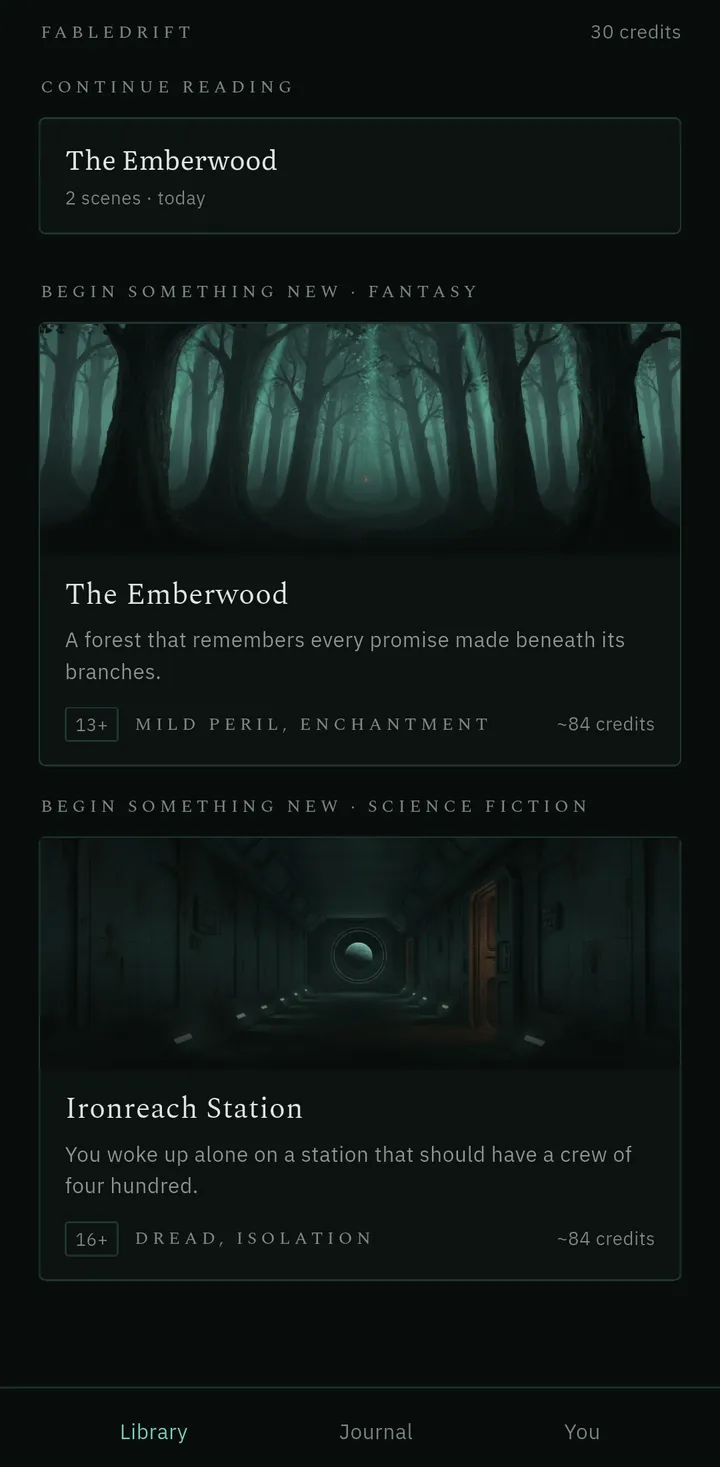
The screenshot above is the whole design argument in one frame. Cost appears twice: once as what you hold, once as what a story is likely to take. Neither number follows you into the text.
What to ask before you buy story credits
Four questions separate a priced product from a metered one. Ask them in the store listing, before you install, and take an unanswered one as an answer.
- What does one credit buy, in scenes? If the app cannot say, the number is not a price, it is a dial.
- What does a whole story cost, not a month? Monthly plans hide how far your allowance actually gets you.
- Do unused credits survive? A subscription allowance that resets is a different product from a pack that keeps.
- Is memory included at every tier? If not, the cheap plan is not the same product as the expensive one.
The platform checklist in our guide to what to check before installing an AI story app for Android covers the rest of the store-listing questions — consent, offline expectations, and how pricing is disclosed. Credits are worth understanding for the same reason a book’s page count is: not because you will count them, but because knowing the size of the thing lets you stop thinking about it and read.
Frequently asked questions
What is a credit in an AI story app?
A credit is a unit the app invents so it can charge you a fixed price for an action whose real cost varies. Underneath, the app is billed per token by the model provider, and it converts that variable bill into a round number you can count.
Are credits the same as tokens?
No. A token is a real unit of text that the model reads or writes, about four characters of English. A credit is an app's own unit, set by the app, and one credit can cover thousands of tokens or a few hundred.
Why does a longer story cost more per scene?
Because the model is sent the story so far along with your new move, so the input grows with every scene. Apps offset this with caching and by sending structured memory rather than the whole transcript.
Do AI story credits expire?
It depends on the app, and the distinction matters. A subscription allowance is usually a daily or monthly quota that resets and does not carry over, while purchased credit packs may or may not have an expiry date. Check which one you are buying.
How much do AI story apps cost to read?
Most price a session somewhere between a few cents and a few dollars, depending on the model behind the narrator and how long your story runs. The honest way to compare is to ask what a whole story costs, not what a month costs.