How to Play AI Text Adventures and Write Your Move
How to play AI text adventures well comes down to one habit: write your move as a sentence with a single intention, in your character's voice.
How to play AI text adventures well comes down to one habit: write your move as a sentence with a single intention in it, in the voice of the person you are playing. The narrator reads your input as prose and answers in kind, so a keyword returns a shrug and a specific line returns a scene. Which app you use, and which model sits behind it, matters less than that.
A move in an AI text adventure is read as a sentence, so write it as one, with a subject, a verb and a target. One intention per turn gives the narrator something to dramatize; three intentions force it to summarize. Dialogue usually moves a scene faster than a search, because a spoken line puts an obligation on somebody else. Vague input produces vague prose, and the fault is more often in the move than in the model. Impossible moves are worth making, because a well-built narrator turns them into a scene instead of an error.
How to play AI text adventures: one intention per move
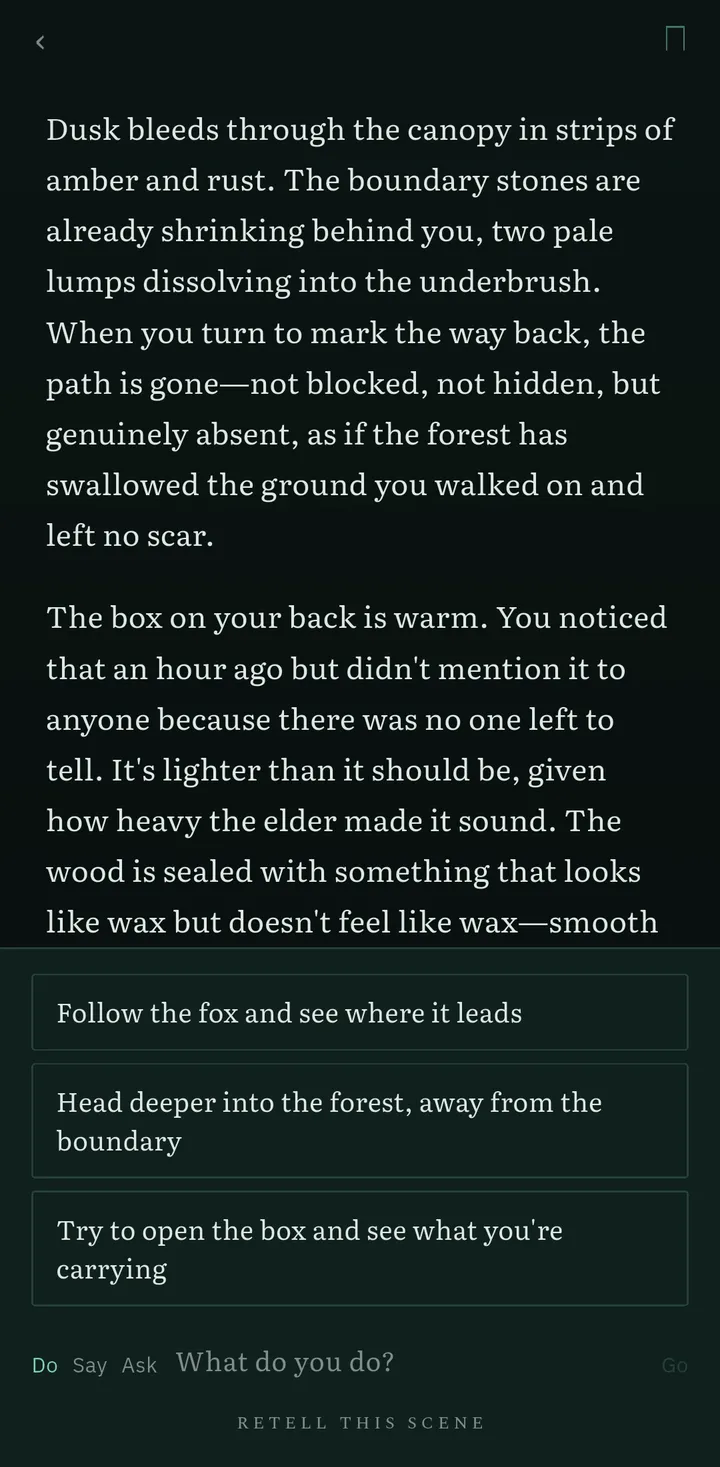
Give the narrator exactly one thing to resolve. A move that contains a search, a conversation and an exit forces the scene to compress all three into a paragraph of summary, and summary is where the prose flattens. One intention leaves room to slow down: the drawer sticks, the letter is addressed to someone else, someone is standing in the doorway when you turn back around. The openings printed under the scene are offers rather than a menu, which is a craft of its own: how suggested actions in interactive fiction are written.
A workable move has three parts, and you can check them in about a second:
- An actor. You, doing something. Not the world in general, and not a wish about what should be true.
- A specific target. The desk, not the room. The woman with the burned hand, not “someone”.
- A reason a reader could feel. You are looking for a name, avoiding a sound, buying time.
Length is not the point; precision is. Three lines of elaborate scene-setting will not help if none of it says what you are doing. A nine-word sentence with a verb and an object in it will. The opening move is the one exception worth treating separately, because it sets a register the narrator keeps: see how to start an AI story the narrator can hold.
Why two-word commands make the prose worse
The habit comes from somewhere real. As Wikipedia’s history of interactive fiction notes, the first text adventure parsers could only handle two-word sentences in the form of verb-noun pairs, and a generation of readers learned to type in that clipped dialect. The parser rewarded it. Anything longer was a guessing game about vocabulary.
An AI narrator fails in the opposite direction. It accepts almost anything, which means it never corrects you, and it returns roughly the amount of material you handed it. “Go north” is a complete and answerable instruction, so you get a corridor. Nothing was wrong; nothing was interesting either.
There is a second, stranger cost to the clipped style. AI Dungeon’s help pages describe how its Do mode “usually adds ‘You’ to the beginning of your inputs, and converts any first-person words (I, me, my, mine, etc.) outside of quotes into second-person” — and warn that leaning on that one shape produces sentences that all begin the same way. Their advice is to vary how you start your inputs. Rhythm in your moves becomes rhythm on the page.
Good moves and flat moves, side by side
The difference is rarely effort. It is usually one added target or one removed intention.
| Flat move | Better move | What changed |
|---|---|---|
| look around | I check the desk drawers for anything with the captain’s name on it | A target and a reason |
| attack the guard | I swing the lantern at the guard’s knee and go for the stairs | A specific act with a consequence |
| talk to her | “You knew my sister. Say her name.” | Dialogue instead of a report |
| go north | I follow the sound of running water, keeping one hand on the wall | A motive attached to the movement |
| I search the room, pick the lock and read the letter | I kneel at the lock with the pin I kept | One intention instead of three |
| be brave | I stay where I am and let him finish the sentence | An action instead of an adjective |
The last row is the one people find hardest. Adjectives about your character — brave, careful, furious — are instructions to nobody. Narrators can only work with what you do, so convert the mood into a movement and let the reader infer the rest, exactly as a novelist would. The third row has a craft of its own, set out in how to talk to characters in AI stories.
What to do when a scene comes back wrong
Read your own move again first. Four faults account for most disappointing scenes, and all four are cheap to fix.
It was vague. No target, no motive. Rewrite it with a noun in it. It was crowded. Split it across two turns and let the first one land. It stated an outcome, not an attempt. “I convince the guard” asks the narrator to ratify a result; “I tell the guard the inspector sent me” gives it something to test. It was out of character. A move that contradicts the person you have been playing makes the narrator choose between your input and its record of the story, and one of them has to give.
When a scene lands wrong anyway, the remedy is structural rather than clever. In Fabledrift, our interactive fiction app for Android, retelling a scene and stepping back to your own earlier scene are both free and always available, so a bad turn costs nothing but the thirty seconds you spent on it. That matters more than it sounds. A reader who is afraid of wasting a turn plays defensively, and defensive reading is dull reading. Which of the two you want depends on where the fault sits, a distinction we untangle in what undo really does in an AI story game.
If the problem is not the scene but the record — a name drifting, a promise dropped — that is a memory problem rather than a phrasing one. It has its own causes and its own fixes, which we set out in why AI story games forget. Systems that let you write your own notes are worth using for exactly this: state the thing you want kept, in one line, and stop repeating it in every move.
Moves that push at the edges of the world
Test the edges early. It tells you what kind of system you are in. NovelAI’s documentation for its text adventure mode is unusually candid about the mechanics: an action there is treated as “a player action, not an in-character action”, so you are “only stating what your character intends to do in the story, not what’s actually happening in the narrative”, which is why the narrator sometimes declines to repeat you word for word. The same page notes that a more detailed action gets followed more literally, while a sparse one leaves the AI more room to interpret.
Use that deliberately. Write thin when you want to be surprised, thick when you have a picture in your head that you want on the page. And make the occasional impossible move — walk into the sea, address the narrator’s own description, ask a dead man a question. A weak system returns an apology. A good one turns the attempt into a scene, which is the whole reason the form left parsers behind, and the reason its lineage is worth knowing if you have just arrived from gamebooks or AI interactive fiction of the older kind.
Two other moves are legitimate and underused. Asking the narrator a question without advancing the story is the equivalent of re-reading a paragraph; it costs nothing and often surfaces a detail you missed. And naming an ending — deciding, somewhere in the middle, what would make this story finished — gives a scene-by-scene narrator the one thing it cannot invent for itself.
An hour’s practice, one intention at a time
Take a single session and hold to one rule: every move is a sentence, with a verb, a target and a reason. Say at least one line of dialogue in every scene. When a paragraph comes back flat, do not blame the model until you have reread what you gave it. By the end of the hour you will be able to feel the difference between a move that opens a scene and a move that closes one, and that instinct transfers to every app in the category.
Frequently asked questions
What should I type in an AI text adventure?
Type a full sentence describing one thing your character does or says, with a specific target: "I check the desk drawers for anything with the captain's name on it" rather than "search room". The narrator is reading your input as prose, so a sentence gets a scene and a keyword gets a shrug.
Do AI text adventures still use commands like "go north"?
They accept them, which is the trap. Two-word commands are a habit inherited from parser games, and a language model will answer them literally and briefly. Attaching a motive to the movement — what you are following, what you are avoiding — changes what comes back.
What is the difference between a "do" action and a "say" action?
A do action states something your character attempts; a say action states a line of dialogue, which usually returns in quotes and forces another character to respond. Dialogue tends to move a scene faster than searching an object, because it puts an obligation on somebody else.
Why does the AI narrator ignore part of what I wrote?
Usually because the move contained more than one intention, so the scene had to summarize instead of dramatize. It can also happen because you stated an outcome rather than an attempt; most narrators treat your input as what your character tries to do, and decide for themselves whether it works.
What happens if I try something impossible?
In a well-built AI text adventure, an impossible move becomes a scene rather than an error message: the attempt happens, fails in a way that says something, and leaves the story further along than it was. That is the main advantage the form has over a parser, and it is worth testing early.