AI Narrator Tiers Explained by What Prose Does
AI narrator tiers change the prose, not the memory. What a higher tier buys you per scene, how to hear it in one scene, and when the free one is plenty.
AI narrator tiers rank the prose, not the story. A higher tier generally buys denser sentences, steadier minor characters and less predictable phrasing out of the same remembered facts; in a well-built app it does not buy a longer memory or a different plot. The useful question is therefore not which tier is best, but which tier the scene in front of you actually needs.
- AI narrator tiers differ in voice and in cost per scene, not in what the story remembers.
- Published prices for the models behind such tiers span a factor of four on generated text.
- A richer narrator shows its value most in dialogue, subtext and rooms with several people in them.
- A free narrator is enough for exposition, travel and any scene you mainly want the facts of.
- Switching narrator mid-story is normal when memory is kept outside the model.
What do AI narrator tiers actually change?
Three things, in order of how plainly you will notice them: sentence density, consistency under pressure, and willingness to surprise you. Density is the easiest to see — a richer narrator spends more words on the specific and fewer on the generic. Consistency is the one that matters at scene forty, when four named people have opinions and a promise is coming due. Surprise is the hardest to price and the reason some readers pay.
What a tier does not change
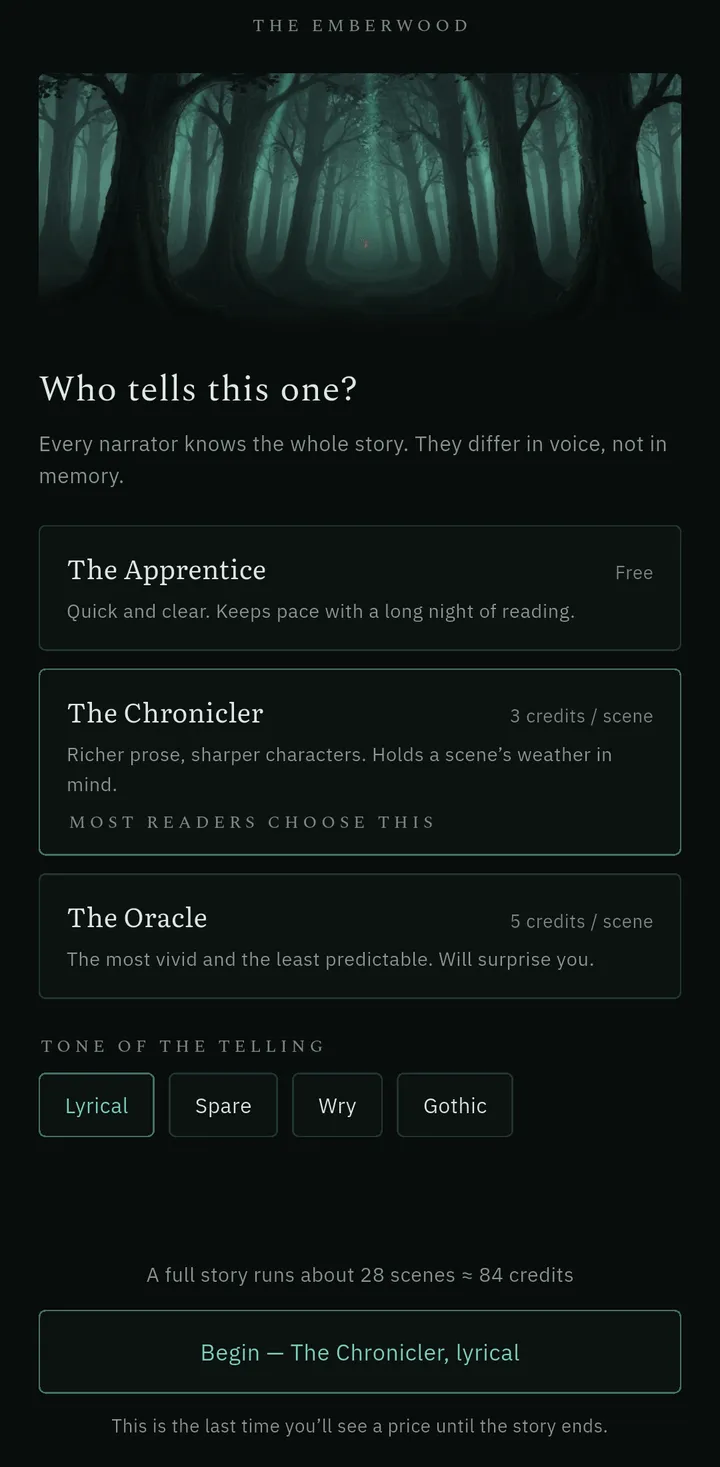
The record. In an app that keeps the story’s facts, characters, places and promises in a structure of their own and hands that structure to the narrator on every turn, the record does not get smaller because you chose a cheaper voice. Fabledrift, an interactive fiction app for Android, is built that way on purpose: every narrator is given the whole memory, and memory is never sold as an upgrade. Tiers buy telling, not knowing.
Why does a higher narrator tier cost more per scene?
Because the model underneath charges more for every word it generates, and a scene is generated fresh each time you act. Anthropic’s published model table lists output at $10 per million tokens for Claude Sonnet 5.5, $20 for Claude Opus 5.5 and $40 for Claude Fable 5.2, with comparative latency given as “Fast” for the first and “Moderate” for the other two. That is a fourfold spread on the text itself, before any difference in what gets sent in.
What gets sent in matters too. Every turn carries the story record — the facts, the standing promises, the people who were in the room — so the input grows as the story does while the output stays roughly the length of a page. A per-scene price reflects that shape honestly. A flat monthly fee hides it, and then has to recover it somewhere else, usually by shortening what the narrator is allowed to remember.
In Fabledrift the arithmetic is visible rather than implied: one credit buys one scene from the Apprentice, the Chronicler costs three credits a scene and the Oracle five, and the price is shown once before a story begins and never again while you read. The pricing page lists the plans and credit packs in full.
How can you hear the difference in one scene?
Pick a scene with two people who want different things, then read the result for three signals rather than for general quality. Vague impressions of “better writing” are unreliable after one page; specific failures are not. The three signals are idiom, address and initiative.
| Signal | What to look for | What a weaker telling does |
|---|---|---|
| Idiom | A minor character speaks in a way only they would | Everyone speaks in the narrator’s register |
| Address | The scene answers the sentence you actually wrote | It answers a nearby, easier sentence |
| Initiative | Something happens that you did not suggest | The scene waits politely for your next move |
Run the same move twice on two narrators if the app lets you retell a scene cheaply. In Fabledrift retelling is free on the Apprentice and once a day on the Chronicler and the Oracle, which is enough for an honest comparison without spending much. Stepping back to an earlier scene of your own is always free.
Which AI narrator tier should you start a story on?
Start low and climb when a scene asks you to. This is the order Anthropic recommends to developers choosing between its own models: begin with the faster, cheaper option, test it against the work you actually have, and “upgrade only if necessary for specific capability gaps.” A reader can apply the same discipline with no engineering at all, because the gap announces itself.
| What you are reading for | Where to start | What tells you to move up |
|---|---|---|
| Finding out what happened next | The free tier | Nothing; stay |
| A particular character’s voice | The free tier | Dialogue that could be anyone’s |
| A scene with three people and a secret | The middle tier | Characters agreeing too readily |
| Prose you would reread | The top tier | You stopped noticing sentences |
The same page notes that adjusting how hard a model works “is often a better lever than switching models” — which, translated out of developer terms, is why two narrators built on different models can still feel closer than their prices suggest, and why the gap you hear depends on the scene. A quiet corridor flattens the difference. A negotiation widens it.
Does a cheaper narrator mean a worse story?
No, because most scenes are load-bearing without being demanding. Someone has to walk down the stairs, the weather has to turn, the letter has to be opened before it can be argued about. Those scenes need accuracy to the record and plain competent prose, both of which a free tier delivers. Spending top-tier credits on a corridor is the most common way readers run out of them early.
The failure mode runs the other way too. A reader who stays on the cheapest voice through a confrontation they have been building toward for thirty scenes gets a competent summary of a scene they wanted written. AI narrator tiers are a budget to allocate across a story, not a quality setting to leave alone. Choosing a model for an AI narrator covers what changes in the prose as a story gets long.
It is also worth knowing that voice is not only the model. A narrator is a model plus a set of constraints — what it may describe, how long a scene runs, when it is allowed to refuse you. Two tiers can share a model and still read differently, and writing a narrator persona is mostly the work of deciding those limits.
What to spend your next five scenes on
Read four of them on the free tier and one on the most expensive one you can afford, and choose the expensive one deliberately: the scene where someone finally says the thing. Then read both kinds back to back. If you cannot tell which was which, you have found your tier and can stop paying attention to the question. If you can, you now know exactly what the difference is worth to you in credits, which is a better answer than any comparison table, including the two above.
Sources: Claude models overview and Choosing the right model, both from Anthropic’s developer documentation.
Frequently asked questions
Do higher AI narrator tiers remember more of the story?
In an app where memory is kept outside the model, no. The story record is the same record whichever narrator reads it, so a tier changes the telling and not what is known.
Can I change narrator in the middle of a story?
Yes, in apps that keep memory separately. The next scene is written by the new narrator from the same facts, promises and characters, so the switch shows up as a change of voice rather than a reset.
Is the free AI narrator tier good enough to finish a story?
For most scenes, yes. Exposition, travel and single-character scenes rarely need the extra latitude, and a free tier can carry a story to an ending.
Why is a higher tier priced per scene instead of per month?
Because the cost is incurred per scene. Each scene sends the story record in and gets a few hundred words back, and larger models charge more per word generated.
What should I look for when comparing two narrators on the same scene?
Whether minor characters keep their own idiom, whether the scene answers the sentence you actually wrote, and whether anything happens that you did not suggest.