Choosing an AI Narrator for the Story You Want
Choosing an AI narrator is a question about prose, not price. What the choice changes, what it never changes, and how to decide before the first scene.
Choosing an AI narrator is a decision about prose, not about memory or price. Every narrator in a well-built app is handed the same record of the story; what differs is how much of a scene it is willing to spend, how often it surprises you, and how quickly it hands the turn back. Decide what you want the next hour of reading to feel like, then pick the voice that does that.
- Narrators differ in voice, density and pace; in a well-built app they do not differ in what the story remembers.
- The same narrator never repeats a scene word for word, because generated text is sampled rather than retrieved.
- Research that pairs language models with interactive fiction scores puzzle solving, not prose.
- A richer narrator costs more per scene, which makes the choice partly a decision about how long tonight’s reading will be.
- In Fabledrift the Apprentice is free every day, the Chronicler costs three credits a scene and the Oracle five.
What choosing an AI narrator actually decides
It decides density and pace. A narrator is the author of each sentence, not a voice reading a finished manuscript, so the choice sets how much of the world gets noticed per turn, how far the prose will go before it stops, and how predictable the next paragraph is. It does not decide the plot, the world, or what the story knows about you.
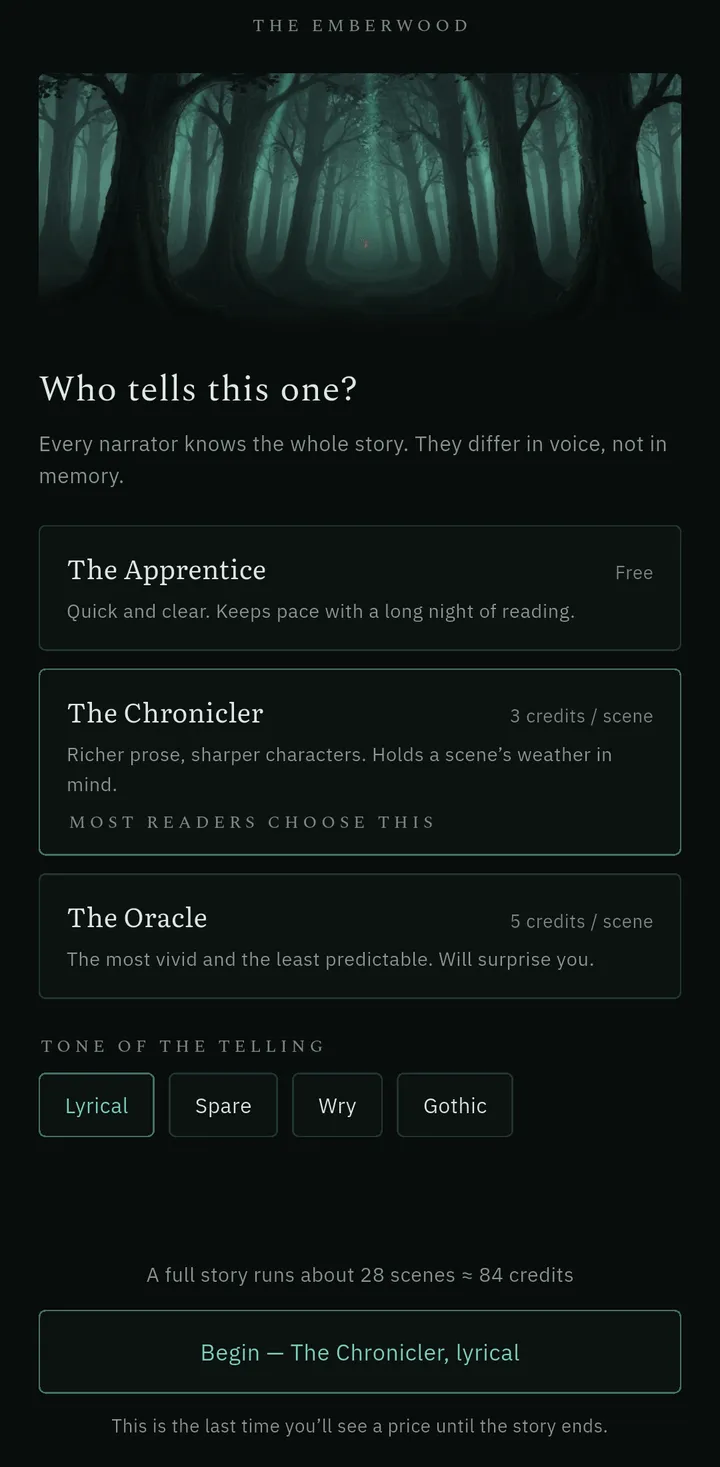
In Fabledrift, an interactive fiction app for Android, that choice is made once, before the first scene, with the cost shown at that moment and never again while you read. The three narrators are the Apprentice, the Chronicler and the Oracle, and what each narrator is for is set out beside the two worlds they tell.
Does a more expensive narrator remember more?
No, and any app where it does has sold you something it should have given away. Choosing an AI narrator should never be choosing how much the story remembers. Memory is an engineering problem solved outside the model: facts, characters, places and promises are kept in a structured record and handed back on every turn, and the narrator writing the sentence has no say in what that record contains.
We treat it that way deliberately. Every reader gets the full memory, at every price, and readers can write their own notes — when a note contradicts the story record, the note wins. A narrator you pay more for notices more in the scene in front of it. It does not know more about the forty scenes behind it.
That distinction is worth checking in any app you try. If the cheap tier forgets your name by scene ten and the expensive one does not, the product is charging you for a database, not for prose.
Why does the same narrator never write the same scene twice?
Because the text is sampled, not retrieved. Hugging Face’s documentation on generation strategies describes the alternative, greedy decoding, as selecting “the next most likely token at each step,” and notes that it “breaks down when generating longer sequences because it begins to repeat itself.” Sampling instead picks tokens according to their probabilities, which “reduce[s] repetition and can generate more creative and diverse outputs.”
This is why “the most vivid and the least predictable” is a coherent description of a narrator rather than marketing. Variation is a dial, and turning it up buys you surprise at the cost of knowing what you are going to get. A reader who wants the story to behave is asking for a different setting than one who wants to be startled.
It also explains why a retell is useful rather than a do-over. Asking the same narrator for the same scene again produces a genuinely different scene, not a correction of the first. In Fabledrift a retell is free on the Apprentice and once a day on the Chronicler and the Oracle, and stepping back to your own earlier scene is always free.
Which narrator suits the hour you have tonight?
Start from the shape of the sitting rather than the price list. A long evening with one world rewards a narrator that lingers; twenty minutes before sleep rewards one that returns the turn quickly. The table below sorts the decision that way.
| What you want tonight | What to pick | Why it fits |
|---|---|---|
| Many scenes, quick turns | The cheapest narrator available | Pace matters more than density when you are covering ground |
| One scene read slowly | The richest one you can afford | Every extra sentence is a sentence you will actually read |
| A story continued after a week | Whichever one you started with | Voice consistency is more noticeable than voice quality |
| A world you have not tried | The free tier first | Nothing is lost if the world turns out not to be yours |
Two of those rows are about continuity rather than quality. A narrator’s voice is the most visible thing in the story, and switching it mid-arc reads like a change of translator. If you expect to be continuing an AI story later, the narrator you can afford to keep using matters more than the one that writes the best single scene.
The free tier is not a demo in this arrangement. Reading with the Apprentice is free every day — five scenes a day in the first week, then one a day, for good — plus thirty welcome credits once. That is enough to learn whether a world holds you before any question of cost arises.
Why no benchmark will choose for you
Because the benchmarks measure a different thing. The standard research harness for machines and interactive fiction, Jericho, describes itself as “a lightweight python-based interface connecting learning agents with interactive fiction games,” and the agents built on it are scored on playing Zork and its descendants well. That is problem solving, measured in points.
Nothing in that work grades a sentence. An agent that maximizes score in a parser game tells you nothing about whether a narrator’s description of a room is worth reading, and the published leaderboards for general model quality are not asking about prose either.
So the comparison has to be yours, and it is cheap to run. Give two narrators the same opening and the same first move, word for word, and read both replies before deciding. The criteria for judging what comes back — specific detail, restraint, consequence, address — are set out in our piece on what makes a good AI narrator. Choosing between two competent narrators is the easier question, and it is mostly a question of appetite.
The question to ask before the first scene
Not which narrator is best, but how much prose you want per move tonight. That single question settles the choice faster than any feature comparison, because density is the only axis the narrators genuinely differ on once memory is off the table. A reader who wants to be carried somewhere quickly and a reader who wants to stand in one room for ten minutes are not disagreeing about quality. They want different books, and on a given evening the same person can be either.
That is what choosing an AI narrator comes down to once the record behind it is sound. Pick accordingly, start the story, and stop thinking about it. The price was shown once for a reason.
Frequently asked questions
Does choosing an AI narrator change what the story remembers?
It should not. Memory belongs to the engine that keeps the record, not to the voice that writes the scene. In Fabledrift every narrator is handed the same facts, characters, places and promises on every turn, and memory is never a paid feature.
Is a more expensive AI narrator a better writer?
It is a denser one. A richer narrator notices more per scene and is less predictable, which is worth paying for in a slow story and wasted in a fast one. Price tracks how much text is generated per turn, not how good the sentences are in the abstract.
Can I change narrators partway through a story?
In Fabledrift the narrator is chosen before the story starts, with the cost shown once and never again while you read. If credits run out you can continue with the Apprentice or ask for a free closing scene, so a story is never left half-finished.
Why do two readings of the same scene come out different?
Because generated prose is sampled from a probability distribution rather than looked up. Hugging Face's documentation notes that sampling strategies "reduce repetition and can generate more creative and diverse outputs," which is the same mechanism that makes a retell worth asking for.
Is an AI narrator the same as an AI voice?
No. A synthetic voice reads words that already exist. A narrator in interactive fiction writes them, composing the scene after you make your move. Most search results for the phrase are about the first kind.