Writing a Narrator Persona Is Mostly Constraints
Writing a narrator persona means fixing what it notices, withholds and refuses. Adjectives about its voice settle nothing when a scene has to arrive.
Writing a narrator persona is less about describing a voice than about deciding what the narrator may not do. Adjectives — wry, ancient, grave — read well in a draft and settle nothing at the moment a scene has to be written. What survives the forty-first scene is the constraints: what the narrator notices first, how much it withholds, what it does with a move that fails, and when it stops.
- A persona governs voice; it must never be the place where a story’s facts are kept.
- An adjective cannot be tested against a scene that came back wrong, so it cannot be fixed either.
- A role with a situation attached is more useful than a role with a trait attached.
- The clauses that keep working late in a story are limits, not descriptions.
- When a persona and the story record disagree, the record has to win.
What goes into writing a narrator persona
Three things, in descending order of usefulness: constraints on perception, constraints on withholding, and a short register note. Constraints on perception say which detail the narrator reaches for first — a smell, a sound, what someone’s hands are doing. Constraints on withholding say what it is not allowed to explain yet. The register note is one or two sentences, and it is the part most drafts spend all their words on.
The order matters because of what a scene actually needs. By the time a narrator writes scene twelve it has a record of facts, an open promise or two, and a reader’s move. It does not need to be told it is mysterious. It needs to be told whether a character’s inner state may be stated outright or only inferred from what they do.
A test for whether a clause belongs
Read the clause and ask what two scenes it would separate. “Atmospheric and evocative” separates nothing; every scene passes. “Never name an emotion the reader could not have observed” separates a great many, and you can tell within one paragraph which side a scene fell on. Keep the clauses that divide, cut the ones that only flatter.
Why adjectives stop working at scene forty
An adjective is spent on the first page. On page one the narrator has nothing but adjectives to work with, so “grave” and “spare” visibly shape the prose. By scene forty the page is crowded with material the story has accumulated — a debt owed, a door left open, a name the reader gave someone — and the question is no longer how to sound but what to leave out. Adjectives have no opinion about that.
Constraints still do. “End the scene on the reader’s next decision, not after it” keeps deciding something on every turn for as long as the story runs. So does a rule about how long a passage of dialogue may go before the room is described again. These clauses are boring to read and they are the ones that hold.
This is also why a role works better with a situation attached than with a trait attached. Anthropic’s chapter on role prompting makes the point with a small example: “‘You are a cat’ produces quite a different response than ‘you are a cat talking to a crowd of skateboarders.’” The audience and the occasion did more work than the noun.
Which constraints are worth writing down
Five, in our experience, and each one is checkable against the scene that comes back.
| Constraint | What it decides | How you check it |
|---|---|---|
| What to notice first | Whether a scene opens on a body, a room or a sound | Read the first sentence of twenty scenes and sort them |
| What to withhold | Whether a motive is stated or left to be inferred | Look for emotions named that nobody could have observed |
| How a failed move reads | Whether an attempt that misses still changes the scene | Make an impossible move and see if a scene or an error comes back |
| Where the scene ends | Whether the reader is handed a decision or a result | Check whether the last line needs an answer |
| Density per scene | How many new nouns a scene may introduce | Count proper nouns that were not in the record |
The fourth row is the one readers feel without being able to name. A scene that ends after the consequence leaves nothing to do; a scene that ends on the edge of a decision is why the next one gets opened. That constraint belongs in the persona and nowhere else, because it is a property of telling, not of the world.
Can a persona hold facts about the world?
It should not, and the reason is maintenance rather than theory. A persona is edited between releases. A story’s record is edited every scene. The moment the same fact lives in both, one of them goes stale and the narrator is handed a contradiction it has no way to resolve. We keep the division strict: the persona knows how to tell, the record knows what happened.
Authored interactive fiction splits the same way, with the halves in different places. Ink’s own documentation describes the language as “built around the idea of marking up pure-text with flow,” and keeps world state separately in variables, with “a simple yet powerful system for tracking state-changes.” The prose is written by hand there and generated here, but the line between voice and state sits in the same place.
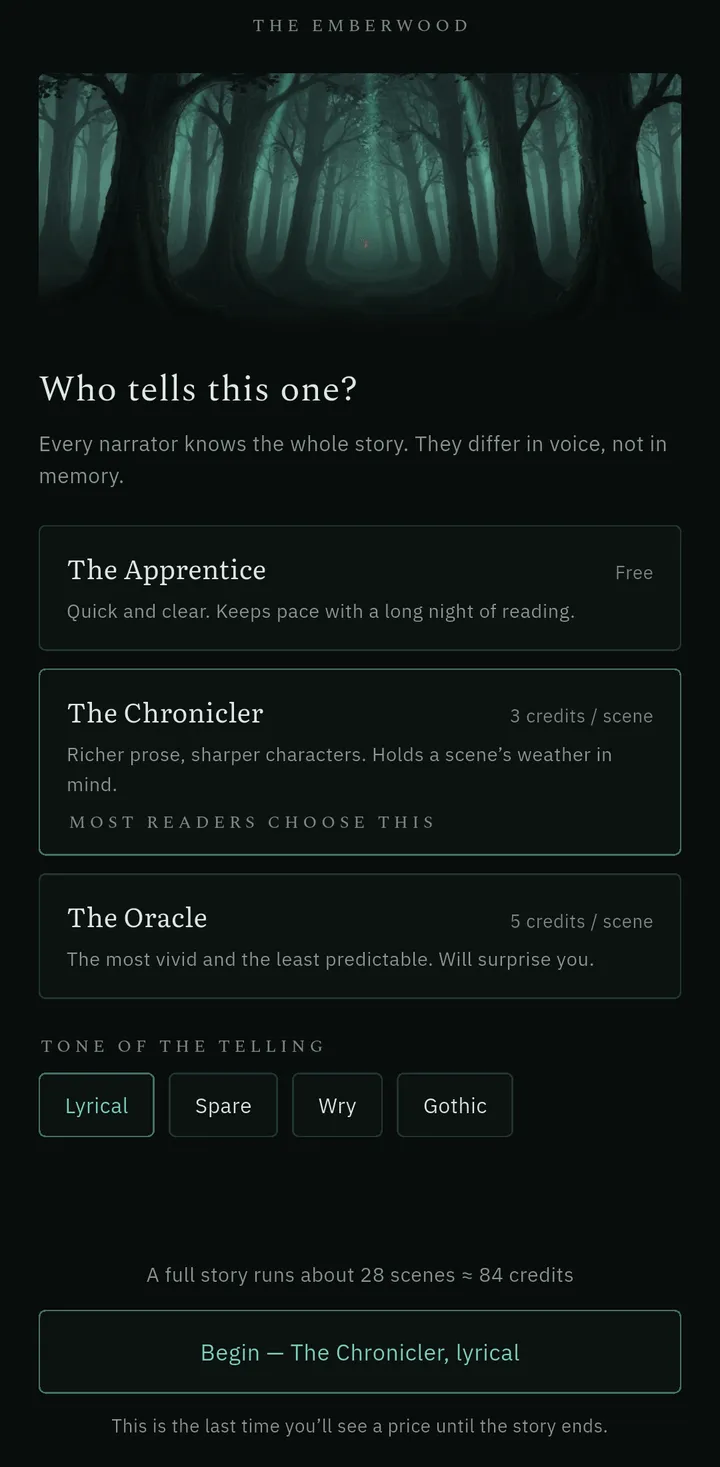
That line on the narrator screen — every narrator knows the whole story, they differ in voice, not in memory — is the division stated to the reader. It is also the reason a persona can be rewritten without endangering anyone’s story in progress. Fabledrift, an interactive fiction app for Android, hands every narrator the same structured record of facts, characters, places and promises on every turn, whichever narrator is telling it.
How do you test a narrator persona?
The part of writing a narrator persona that most drafts skip is subtraction: run the same scene twice with one clause removed. Freeze a memory snapshot from the middle of a real story, freeze the reader’s move, then generate with and without the clause under test and read the two scenes side by side. If you cannot tell which is which, the clause is decoration and can come out of the file.
What this does not test is obedience to the record, which is a property of the model underneath rather than of the words you wrote about voice. We audition those separately, and the method for choosing the model behind an AI narrator starts from the middle of a story for the same reason this does. Page one flatters everything.
The third thing worth testing is what happens when a reader’s note contradicts the persona’s instinct. A narrator told to withhold motives still has to honor a reader who wrote down that their character says exactly what they think. The note wins, and making an AI narrator forget a stale fact works the same way: a new fact beats an old one, and both beat a preference about style.
What stays in the file
Roughly a page, most of it negative. Four clauses about perception, three about withholding, two sentences of register, and one rule about where a scene ends. Each narrator in the two worlds and three narrators shares that spine and differs in density: the Apprentice is free to read every day, the Chronicler and the Oracle cost credits a scene and spend them on specificity rather than on new plot.
Everything we cut while writing a narrator persona was an adjective. The drafts that read best in a text editor produced the scenes that read worst on a phone, because a prompt written to sound like a narrator competes with the scene for the same attention. The file is not meant to be good prose. It is meant to make good prose the only thing left to write.
Frequently asked questions
What should a narrator persona actually contain?
Limits rather than adjectives: what the narrator notices first in a scene, how much it withholds, what it does with an action that fails, and when it stops. Each of those can be checked against a scene that came back; a word like "wry" cannot.
Does giving an AI a role change more than its tone?
Yes. Anthropic's prompt engineering tutorial states that role prompting "can also change the style, tone, and manner" of a response, and that "content adapts to the new role." A role is an instruction about substance, not only about register.
Should the narrator persona hold facts about the world?
No. Facts belong in the story record the narrator is handed on every turn. A persona is rewritten between releases; the record is rewritten every scene, and the two drift apart the moment they hold the same fact twice.
Why do narrator voices flatten out over a long story?
Because an adjective has no work to do once the scene has material in it. Constraints keep deciding something on turn forty — what to leave out, when to cut — while a trait has already been spent on the first page.
Do different narrators remember different amounts?
Not in Fabledrift. Every narrator receives the same structured record of facts, characters, places and promises, and memory is never a paid feature. Narrators differ in density and price per scene, not in recall.