Suggested Actions in Interactive Fiction, Not Menus
Suggested actions in interactive fiction should widen what you try, not narrow it to a menu. How to write openings that leave the page open.
Suggested actions in interactive fiction work best as offers, not as a ballot. A good suggestion names something the scene already contains and leaves you free to do something else with it; a bad one hands you three finished plans and quietly retires the one you had. The difference is not how many options sit under the prose, but whether their wording closes the page or opens it.
- A suggested action is a reading aid: it shows what the scene treats as live, not the limit of what you may try.
- In choice-based tools the list is the whole input surface, and ink’s documentation states that “input is offered to the player via text choices”.
- ink makes every choice once-only unless the author marks it sticky with a
+bullet, so an authored option can be spent in a way a suggestion never is.- ChoiceScript’s
*choicecommand “presents the user with a list of options”, which is why menu wording has to be exhaustive and a suggestion’s does not.- Two to four openings is enough; the fourth usually restates the third, and a longer list reads as a form to fill in.
What are suggested actions in interactive fiction?
They are the short lines printed beneath a scene that name something you could do next. In a choice-based story they are not suggestions at all but the input itself, since picking one is the only way to continue. In a story that accepts free text they work more like stage directions for the reader, marking which parts of the scene the narrator is ready to resolve.
That second kind carries a quieter job. A reader arriving in an unfamiliar world does not yet know what the prose will honor. Suggested actions in interactive fiction answer that without a tutorial: if one of them names the sealed box on your back, the box is a thing the story can act on, and so is the strap, and so is whoever gave it to you.
Parser games had the same problem and solved it less gracefully. Inform’s manual, describing how an author names a thing, says it is “assumed that the player would call it that, too” — which holds right up until the reader reaches for a different noun. The gap between the author’s vocabulary and yours is where guess-the-verb lives. A suggestion closes that gap by showing the vocabulary in use instead of waiting for you to find it.
Why does a menu narrow what a reader tries?
Because a finished list makes an implicit claim: these are the moves. In choice-based work the claim is honest. ChoiceScript’s *choice command “presents the user with a list of options”, and ink states plainly that “input is offered to the player via text choices”, so the author has to have written every path before you arrive at the fork.
Completeness has mechanical weight in those systems. In ink, “every choice in the game can only be chosen once” unless it is marked sticky with a + bullet, so an option can be used up. Choice text in square brackets is not printed into the response at all — “the text of the choice will not be printed into response” — which means the option’s wording and the story’s prose are two separate pieces of writing. The menu is interface copy.
None of that is a flaw. It is the cost of a form where every branch is authored in advance, and it is bound up with the older question of whether interactive fiction is a game or a book. The problem is the reading habit it builds. After a few dozen lists you stop composing and start comparing, and comparing is a smaller act than deciding.
| Form | What sits under the scene | What the wording must do | How it usually fails |
|---|---|---|---|
| Parser, as in Inform | Nothing | Teach its nouns and verbs indirectly, through description | Guess-the-verb; a refusal reads as the machine breaking |
| Choice-based, as in ink or ChoiceScript | The complete list of accepted moves | Cover every branch the author wrote, in interface copy | A fork that reconverges so visibly the options feel decorative |
| Free input with suggestions | Two to four openings plus a line for your own words | Point at what is live without finishing the thought | Suggestions phrased as plans, which readers take as the only moves |
Whether the fork matters at all is a separate question from how it is worded, and worth answering on its own terms: see whether your choices actually change an AI story.
How do you write a suggestion that widens the page?
Name a thing, not a plan. “The wax seal on the box has started to soften” leaves you four or five moves; “open the box to find the key” leaves you one, and makes the story’s goal yours before you agreed to it. The first sentence hands you an object. The second hands you an errand.
Three habits do most of the work:
- Point in different directions. If two openings both move you deeper into the forest, one of them is wasted. Aim for one that advances, one that investigates, and one that involves another person.
- Keep them shorter than the prose. A suggestion that runs to two lines is competing with the scene above it, and the scene should win.
- Let one of them cost something. An opening with a visible price — turning back, telling the truth, leaving the lantern — reminds you that the list is not a set of equivalent buttons.
What none of them should do is resolve anything. A suggestion that contains its own outcome (“befriend the fox”) has written the next scene before you have. Stop at the point where you would still have to decide how.
How many suggested actions should a scene carry?
Two to four. One reads as an instruction and makes the next move feel assigned. Two sets up a tension without claiming to be complete. Three is the comfortable number for a scene with a person, a place and an object in it. By five, the list is longer than most paragraphs on the page, and readers scan it the way they scan a settings screen.
The count also signals how open the input is. A long, tidy, mutually exclusive list tells a reader the system wants a selection. A short, uneven one — a thing, a person, a direction — tells them the system expects a sentence.
How Fabledrift writes its openings
Fabledrift, an interactive fiction app for Android, leaves two to four openings under each scene and a line beneath them where you write your own move in your own words. The openings are not the input. They are there for the scenes when you have no idea what to try, and for the first page of a world you have never read.
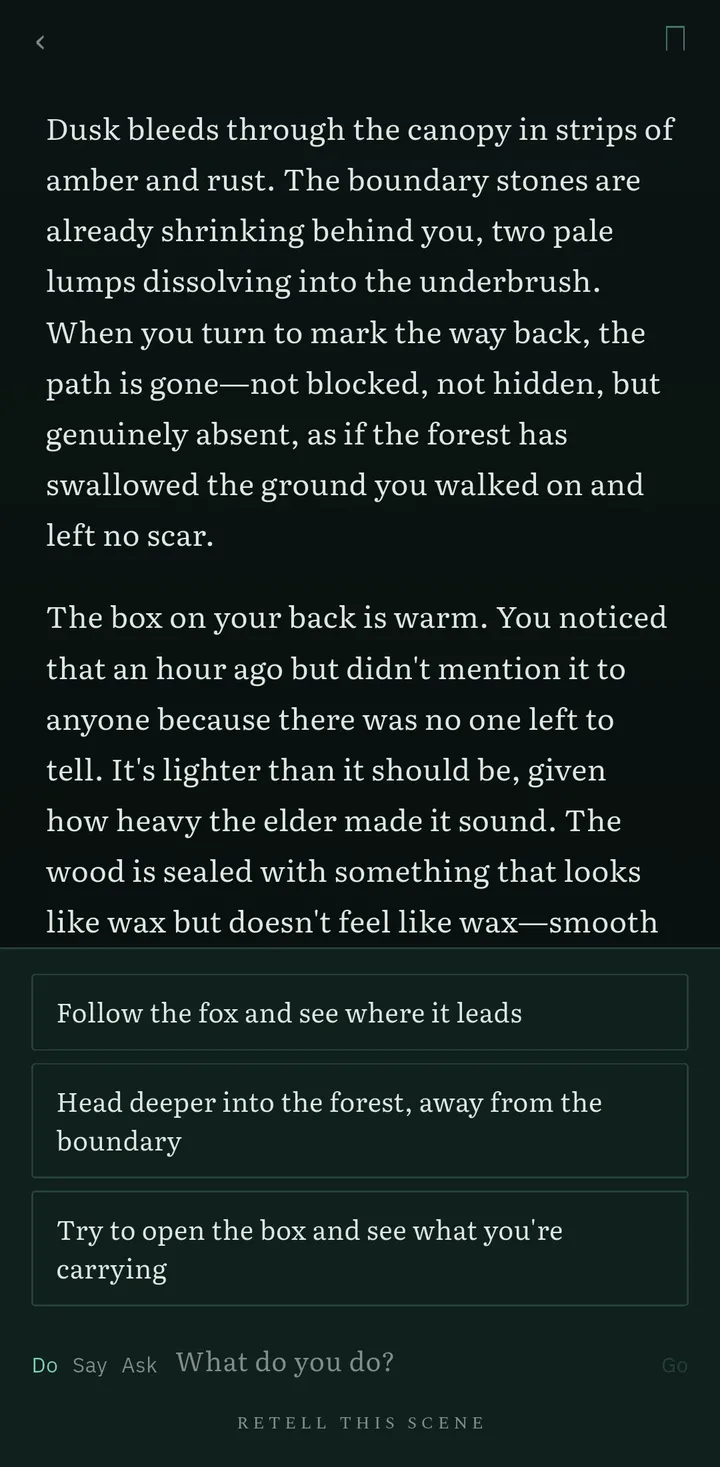
Two decisions follow from treating openings as hints. A move the suggestions never mentioned still has to work, including one the world cannot grant: an impossible attempt becomes a scene rather than an error message. And the suggestions stay inside the story, which is why none of them is ever about the story — asking the narrator a question is a separate thing you can do, not a fourth option on the list.
The harder part is writing openings that are specific without being prescriptive, scene after scene, with nothing pre-written. A narrator that forgets what it put on the page an hour ago will offer you the box twice, or offer a door that was locked three scenes back. The openings are only as good as the record the narrator is handed each turn.
A test to run on the next scene you read
Suggested actions in interactive fiction are easy to judge from the reader’s seat, and it takes one scene. Read the suggestions, then cover them and write down what you would have done. If your move is one of the three, the openings were well judged. If your move was impossible to think of until you read them, they taught you something about the world. If your move was there all along and the list quietly talked you out of it, the suggestions were doing the deciding — and that is the only failure that matters.
Sources: ink’s Writing with ink documentation, the ChoiceScript authoring guide, and Writing with Inform.
Frequently asked questions
What are suggested actions in interactive fiction?
They are the short lines printed under a scene that name something you could do next. In a choice-based story they are the only input the game accepts; in a story that takes free text they are hints about which parts of the scene the narrator is ready to resolve.
Do suggested actions mean the choices are fake?
Not by themselves. A suggestion is fake when every option leads to the same next scene, not when the list is short. The test is whether the story a few scenes later still carries a trace of which one you took.
How many suggested actions should a scene show?
Two to four. One reads as an instruction, and past four the list starts repeating itself in different words while the prose above it loses the reader's attention.
Can you ignore the suggestions and write your own move?
In a system that accepts free text, yes, and the suggestions are written on the assumption that you often will. In choice-based tools like ink or ChoiceScript you cannot, because the list of options is the whole input surface.
Why do suggestions sometimes make a story feel railroaded?
Usually because they are written as complete plans rather than as things in the scene. A line like "search the cellar for the key" tells you the goal and the method, which leaves you agreeing rather than deciding.