What the AI Narrator Remembers, and How to Fix It
What the AI narrator remembers is a short record you can read: names, promises, open threads. How to check it and correct an entry that is wrong.
What the AI narrator remembers is not the text of your story. It is a short, structured record — names, places, promises made, threads left open — rebuilt after every scene and handed back to the model before the next one. In an app that shows you that record, you can read it, and when it is wrong you can correct it before the mistake hardens into canon.
- The narrator is given a compact record of your story, not the full transcript.
- A memory record usually holds facts, characters, places, promises and open threads.
- An error left in the record tends to repeat, because each new record is built from the last one.
- In SillyTavern, World Info entries are inserted only when their keywords appear in the text.
- In Fabledrift the journal is open to every reader, and a reader’s note beats the story record.
Why the narrator needs a record at all
A language model has no memory between turns. Everything it knows arrives in the prompt it is handed, and that prompt has a fixed size, so a story of any length cannot be resent whole. The record is the workaround: a compressed account of what matters, small enough to travel with every scene. It is what carries chapter one into chapter nine, and why AI story games forget is mostly a story about that record failing.
The second consequence is less obvious. Each record is built from the previous record plus the newest scene, so it inherits its own mistakes. A name misheard in dialogue, a door described as locked when you left it open, a character you never agreed to trust — written down once, these arrive in every prompt afterward. The prose can be edited. The record, in most apps, sits underneath and keeps going.
How do you see what the AI narrator remembers?
You open the app’s memory panel, whatever it is called there. The names diverge more than the idea does, and the differences that matter are who writes the entries and whether you can change them.
| Where | What the record is called | Who fills it in |
|---|---|---|
| SillyTavern | World Info, also called lorebooks or memory books | You, entry by entry |
| AI Dungeon, with the Auto-Cards script | Story cards | The script, watching the story |
| Fabledrift | The story journal | The narrator, plus your own notes |
SillyTavern’s documentation describes World Info as “a powerful tool available in ST to insert prompts dynamically into your chat,” working “like a dynamic dictionary that only inserts relevant information from World Info entries when keywords associated with the entries are present in the message text.” That last clause is the part readers trip over: an entry that never gets triggered is, for the length of that scene, not remembered at all.
The other direction is automation. Auto-Cards, a scenario script for AI Dungeon, “watches your story and automatically writes plot-relevant story cards during normal gameplay,” which its author frames as an attack on the “object permanence problem.” Both approaches are legitimate. Neither removes the need to look at the result.
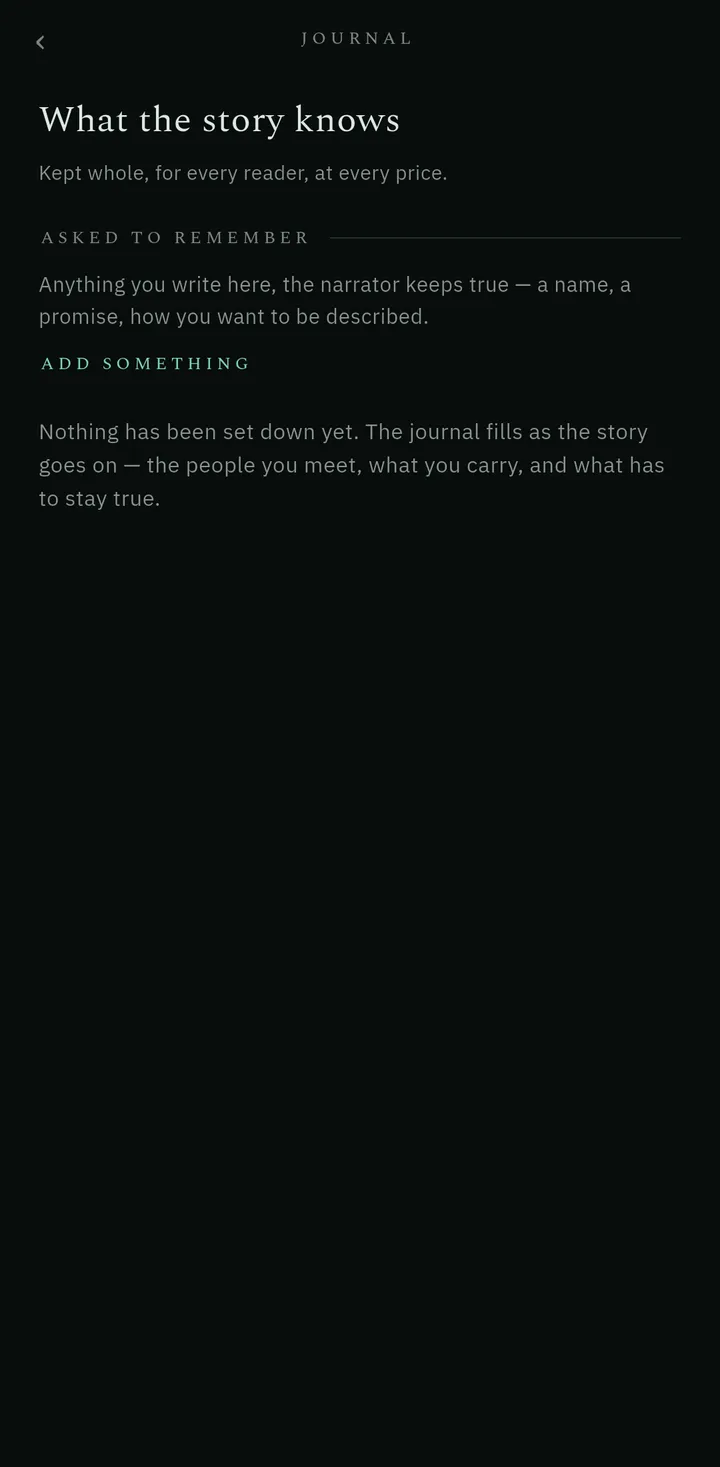
In Fabledrift, an interactive fiction app for Android, that screen is the story journal, and it is not a paid tier. Every reader gets the full memory, because a story that forgets your sister’s name is not a cheaper story, it is a broken one.
What a good memory record holds
Five kinds of entry do most of the work. If a panel shows you nothing but a wall of summary prose, it is a recap, not a record — useful to read, much harder to correct.
- Facts. Flat statements the story has committed to: the season, the debt, the name of the ship.
- Characters. Who they are to you, what they want, what they last did.
- Places. Where things are, and what state you left them in.
- Promises. Anything you or a character swore to do, which is the category most often dropped.
- Open threads. Questions the story has raised and not answered.
Characters are the entries worth auditing first. A narrator can hold a person’s voice perfectly steady while losing everything that person did, which is the difference between AI characters that remember you and characters that remember the story.
Entries compete for room. SillyTavern’s docs describe a token budget for inserted background information, and once that budget is exhausted no further entries activate however well their keywords match. The practical rule is the same everywhere: one short sentence per entry beats a paragraph, because a paragraph crowds out three other things the scene also needed.
How to correct an entry that is wrong
Correct it the moment a scene lands wrong, not at the end of the chapter. A wrong entry is cheap to fix while it has been used once and expensive after it has been used ten times, by which point later scenes depend on it and fixing the record leaves the prose behind it stranded.
- Read the record after any scene that felt off, before you write your next move.
- Find the entry, not the sentence. The sentence is a symptom.
- Write the correction as a statement of what is true — “Sera is my sister, not my captain” — rather than a complaint about the error.
- Keep it to one line. Long corrections read as new lore and get compressed again.
- Read the next scene to confirm it took.
Point three is the one people get wrong. Negations are weak instructions for a language model and weak entries in a record: “don’t say she is the captain” leaves the word captain sitting next to her name. State the fact you want kept, and let it replace the other.
When your note contradicts the story
Every app that lets you write notes needs an answer to this, and it is worth finding out before you need it. Fabledrift’s answer is that the note wins. Readers can write their own notes — a name, a promise, how they want to be described — and when a note contradicts the story record, the record yields, because you are the authority on your own character and the narrator is not.
The related question is what happens when you go backward. Stepping back to an earlier scene should roll the record back with it; when it does not, the narrator keeps referring to events the page no longer contains. That failure mode, and the four different buttons that hide behind the word undo, are covered in undo in AI story games. If you audit only one behavior in a new app, audit that one.
A two-minute check between scenes
Open the record, read the top five entries, and ask whether a stranger reading only those could write your next scene without contradicting you. That is the whole audit. It is faster than re-reading the chapter, and it catches the class of error that no amount of good prose will fix later, because the prose is downstream of the record — which is also, in the end, how AI narrators work at all. What the AI narrator remembers is a document. Treat it like one, and when the story ends, export the AI story as text so the reading is yours to keep.
Frequently asked questions
Does an AI narrator remember the whole story?
Almost never the whole text. Most apps keep a compressed record beside the story — names, places, promises, unresolved threads — and hand that record to the model with the most recent scenes.
How do I see what an AI story app remembers?
Open the app's memory panel. It goes by different names: World Info or lorebooks in SillyTavern, story cards in AI Dungeon, a story journal in Fabledrift. If an app has no such screen, you cannot audit its memory.
Can I correct something the AI narrator got wrong about my story?
In an app with an editable record, yes. Write the correction as a plain statement of what is true rather than a complaint about the mistake, keep it to one sentence, and do it before the error is repeated in later scenes.
What happens if my note contradicts what the story already said?
That depends on the app's precedence rule, and it is worth knowing before you need it. In Fabledrift, a reader's note wins over the story record, because the reader is the authority on their own character.
Why does a wrong detail keep coming back after I fix the scene?
Because editing the prose is not the same as editing the record. If the fact was written down when the scene first landed, it will keep arriving in the prompt until the record itself is changed.