Risky Moves in Interactive Fiction Need a Stake
Risky moves in interactive fiction land only when the move names what you could lose. How to write one, and how to read the scene that answers it.
Risky moves in interactive fiction only work when the move itself names something you could lose. A story cannot attach a consequence to a sentence that asks for nothing in particular, and “I try to sneak past the guard” asks for nothing in particular. Write the version that specifies how, and the scene that answers has something specific to take.
- A move that names no particular intention gives a narrator nothing particular to take away.
- The most useful outcome is rarely success or failure, but success with a price named.
- Inform ships an option that switches undo off, so recoverability is an authored decision rather than a property of the medium.
- A free step back moves the decision about risk from the system to the reader; it does not remove it.
- Knowledge is the one stake no reversal returns, because a character cannot unlearn what they saw.
What makes risky moves in interactive fiction work?
Specificity, almost entirely. A risk is a named exposure: this hand, this door, this person’s good opinion. A move that commits to a method — which way you go, what you leave behind, what you say out loud — hands the narrator a surface to damage. A general intention has no surface. It can be granted or refused, and both of those read the same on the page.
The second requirement is not hedging inside the same sentence. “I approach the fox, carefully, ready to pull back if it moves” contains its own escape, and a narrator reading that will usually write the escape, because you asked for it. Decide before you type, then type only the decision. The hedge belongs in your head, where it costs the story nothing.
A test to run before you send it
Ask what the next scene could take from you if this goes badly, and insist on a noun. The lantern. The fox’s trust. The name you gave the innkeeper. If the honest answer is “time” or “nothing really”, the move has no stake in it yet, and no amount of atmosphere in the reply will supply one.
Why does a vague move fail boringly?
Because vagueness is a request for a summary, and summaries have no consequences. Compare two moves in one room. “I search the room” produces a paragraph of findings; nothing in it can go wrong, since you never said where your hands went or how long you were willing to stand there. “I lift the floorboard under the desk and reach in to the elbow” can cost you the elbow.
The specific version also states what you believe about the room, which is the part most readers leave out. A move carries a theory, and stating the theory is what lets the story prove you wrong. Waiting is the one move that deliberately risks nothing; it earns its place by being the exception rather than the default.
What can a move actually put at risk?
Four things, and they are not equally available in every scene. The habit worth building is choosing one before you write, instead of discovering afterward that the move risked nothing you cared about.
| Stake | What a bad outcome costs | What the story must remember | Where it surfaces later |
|---|---|---|---|
| Body | A capability: a hand, a lung, your speed | The injury and what caused it | Moves that are no longer open to you |
| Standing | Someone’s willingness to help you | Who saw it, and what they concluded | A refusal you would not have met before |
| Access | A route, a door, a window of time | That it closed, and who closed it | The long way around, with its own costs |
| Knowledge | Your certainty, and nothing else | What you learned, and when | Every later scene read differently |
Knowledge is the strange row. It is the only stake that cannot be refunded, because returning a character to an earlier scene does not return you to not knowing. Readers meet this the first time they look into something they were warned about, and the warning turns out to have been accurate.
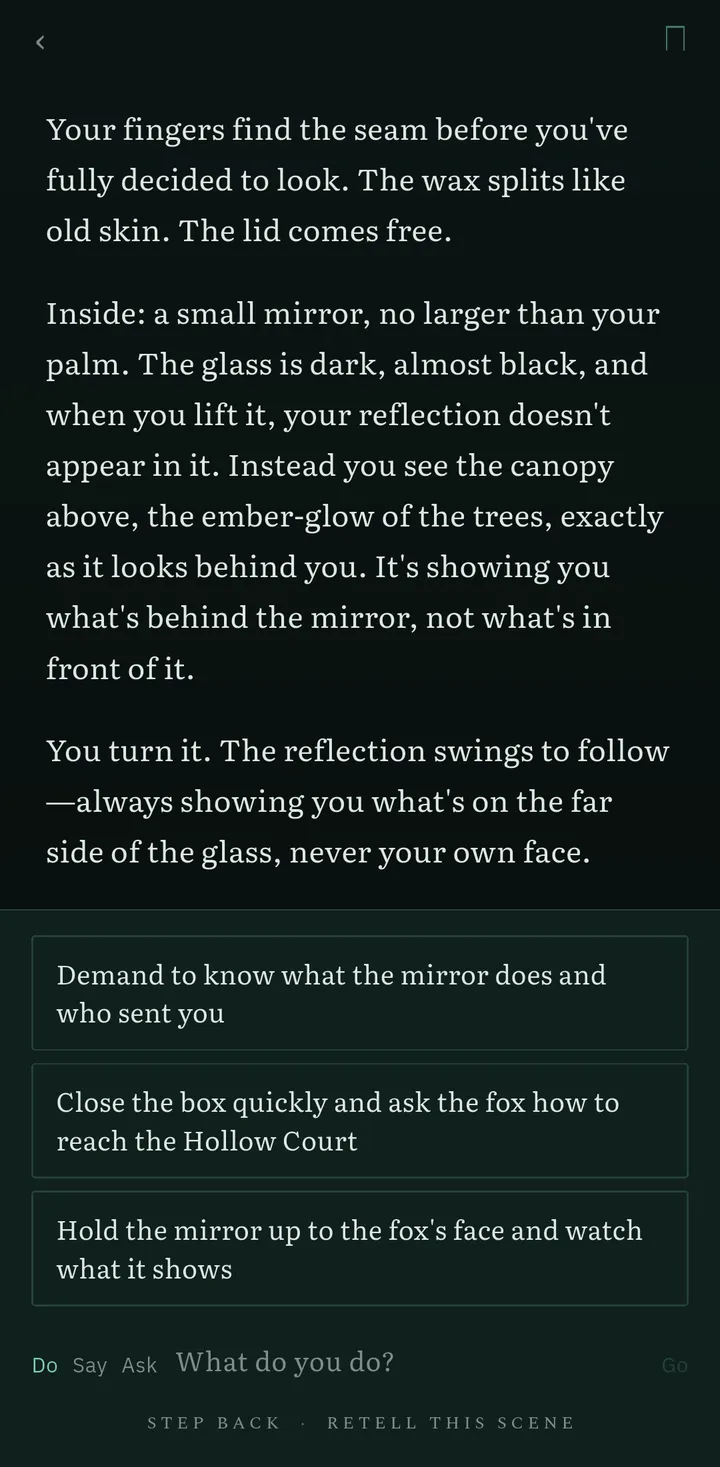
Those three openings are not three flavors of one move. The first spends standing, the second spends nothing, the third spends certainty and cannot be taken back. A scene that offers you options at different prices is doing part of your work; the rest is noticing which price you are actually willing to pay before you tap.
Does a free step back make risky moves meaningless?
It changes who decides, which is not the same as removing the decision. Authored interactive fiction has always treated reversibility as something the author sets. Inform, the system behind a great deal of parser fiction, ships an example called Finality whose stated purpose is “Not mentioning UNDO in the final set of options”, and which adds the line Use undo prevention. to stop the player undoing at all.
That option exists because authors disagree about what a death should mean. When the system refuses to take the choice away, the reader has to supply the weight themselves, and the way to supply it is to mean the first move. A step back used to change your mind is a reader editing a story. A step back used to audition outcomes is a reader reading the same scene four times.
Fabledrift, an interactive fiction app for Android, falls on the reversible side of that line on purpose: stepping back to one of your own earlier scenes is free and always available, and retelling a scene is free with the Apprentice and once a day with the Chronicler and the Oracle. Nothing stops you from undoing a disaster. The interesting readers mostly do not.
How do you read the scene that came back?
Stop sorting outcomes into success and failure. Tabletop design worked this out decades ago and named the middle case. In Ironsworn, whose move text is collected in the Datasworn data set, a weak hit is defined as what happens when “your action score beats (is greater than) one challenge die, but does not beat the other”, and a negative outcome usually comes with “a prompt to Pay the Price”.
Most good scenes are weak hits. You get through the gallery and the lantern is gone. The fox answers and now owes you nothing. Read for the price rather than the verdict, and a scene that looked like a win often turns out to have moved something out of reach.
When the move was impossible to begin with
A move the world cannot allow still ought to produce a scene. The attempt happens, the room reacts, and the refusal is written as part of the story instead of arriving as an error message in place of a scene. This matters for risk because it means the floor under a reckless move is prose, not a rejection, and the honest cost of trying something absurd is that everyone present now knows you tried.
What to risk in the next scene you write
Pick the stake first, then the sentence. Decide whether this move spends your body, your standing, your access or your certainty, and write the version that spends it visibly. Leave the hedge out. Then read the reply for the price rather than the outcome, and write the next move from whatever you have left.
The readers who get the most out of risky moves in interactive fiction tend to be the ones who are not protecting anybody. Playing a character unlike yourself helps, because the instinct to keep a protagonist safe is mostly an instinct to keep yourself comfortable. A story you cannot lose anything in is a story you are reading at a distance.
Frequently asked questions
How do you write a move that can fail?
Name the method, not the goal. "I search the room" cannot go wrong, because you never said where your hands went; "I lift the floorboard under the desk and reach in to the elbow" can cost you the elbow.
What does failing forward mean in interactive fiction?
It means a failed attempt moves the story somewhere new rather than resetting it. The attempt still happens, the situation changes, and what you lost becomes material the next scene has to work with.
Does free undo ruin the stakes in a story?
Only if you use it to avoid outcomes rather than to change your mind. Reversibility moves the decision about risk from the system to you, which is why the first move you write still has to mean something.
What can a single move actually put at risk?
Four things, in practice: your body's capabilities, someone's willingness to help you, access to a route or a window of time, and certainty. Knowledge is the one that cannot be given back.
Why do my risky moves keep producing nothing?
Usually because the move hedges inside its own sentence. A clause like "ready to pull back if it moves" asks the narrator to write the retreat, and a narrator handed an escape route tends to take it.